



Sales Numbers Tell You What Happened — Not Why
For decades, retailers have relied on one primary metric to judge success: sales.
If revenue goes up, things must be working. If it goes down, something must be wrong.
But as retail enters 2026, this way of thinking is no longer enough.
Sales figures only show the outcome. They don’t explain the opportunity behind it — how many people showed interest, how many walked away, or whether a store underperformed because of low demand or poor execution.
That’s where footfall data comes in.
And that’s why footfall should be the first KPI retailers track before looking at anything else.
Why Sales Alone Is Misleading
Let’s look at a simple scenario:
- Store A and Store B both report RM100,000 in monthly sales.
- On paper, performance looks identical.
But once footfall data is introduced, the picture changes:
- Store A had 20,000 visitors
- Store B had 8,000 visitors
Suddenly, we see two very different realities:
- Store A has high traffic but weak conversion
- Store B converts fewer visitors into more sales per shopper
Without footfall data, these insights remain invisible.
Sales alone can hide:
- Poor store layout
- Understaffing during peak hours
- Ineffective merchandising
- Missed marketing opportunities
Footfall doesn’t replace sales data — it explains it.
Footfall Is the Clearest Indicator of Demand
Footfall answers one of the most important retail questions:
“Are customers interested enough to walk in?”
It measures:
- Demand by location
- Mall or street attractiveness
- Campaign-driven traffic
- Brand pull versus surrounding competition
When footfall drops, it’s often an early warning sign — long before sales decline.
When footfall rises but sales don’t, it highlights execution gaps inside the store.
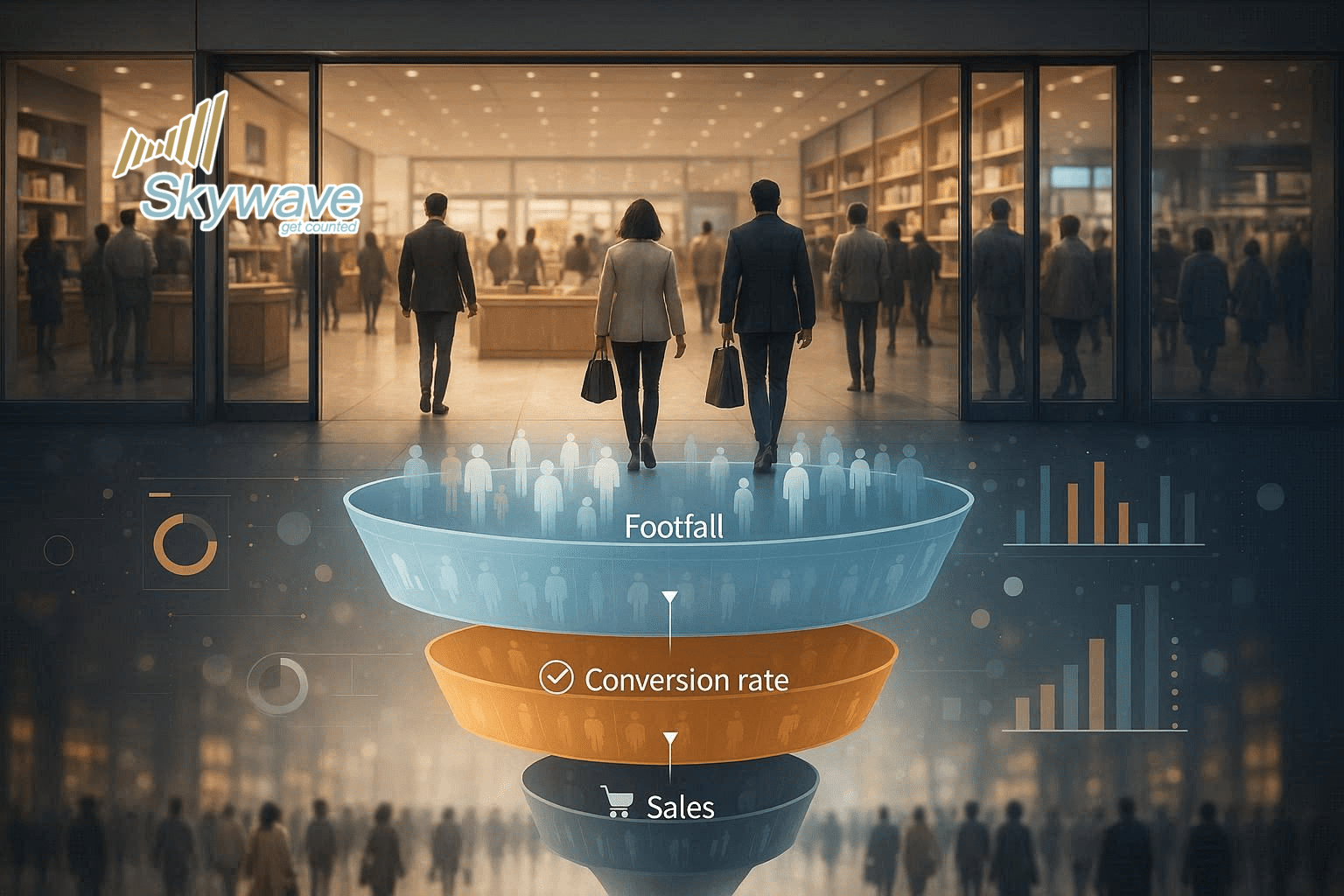
In this sense, footfall is the top-of-funnel KPI for physical retail — just like website traffic is for e-commerce.
Conversion Is the KPI That Truly Measures Performance
Once footfall is tracked, retailers unlock one of the most powerful metrics in retail analytics: Conversion rate = Sales ÷ Visitors
This single KPI allows retailers to:
- Compare stores fairly, regardless of size or location
- Identify high-potential stores with underperforming teams
- Separate traffic problems from operational problems
For example:
- A flagship store with high footfall but low conversion needs better staffing, layout, or service
- A quieter store with strong conversion may deserve more marketing support or a better location
Conversion turns footfall data into actionable insight.
What Retailers Are Doing Differently in 2026
Leading retailers across Singapore, Malaysia, and Indonesia are already using footfall as a foundation KPI to:
- Align staffing with real traffic patterns
- Measure campaign effectiveness beyond sales spikes
- Optimize store layouts using dwell time and heatmaps
- Benchmark performance across multiple locations
- Make data-backed decisions on expansion or consolidation
With modern AI-powered footfall sensors, this data is now:
- Highly accurate
- Privacy-safe
- Affordable
- Available in real time
Footfall analytics is no longer a “nice-to-have” — it’s a competitive advantage.
Start With Footfall, Then Build Everything Else Around It
In 2026, the smartest retailers won’t ask: “How much did we sell?”
They’ll ask: “How many people came in — and how well did we convert them?”
Footfall data sets the foundation for:
- Better KPIs
- Better decisions
- Better store performance
If you want to build a truly data-driven retail strategy, start at the door.
Ready to see what footfall data can reveal about your stores?
Start tracking the KPI that comes before sales. Contact – Skywave