

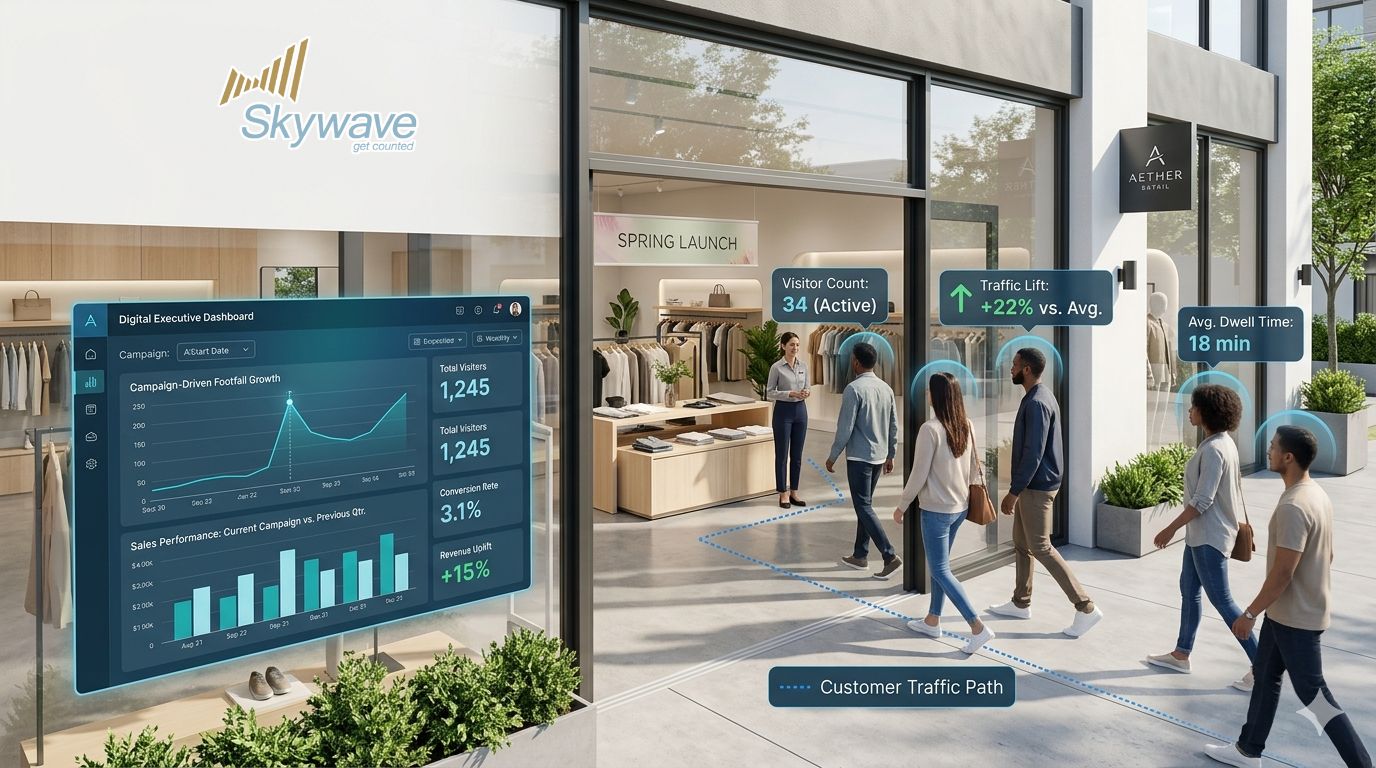
Marketing campaigns are often judged by a single outcome: sales.
A promotion runs for two weeks. Revenue increases by 8%. The campaign is declared a success.
Or perhaps sales remain flat, and the campaign is written off as ineffective.
But is sales performance alone enough to determine whether a marketing campaign worked?
For today’s retail marketers, the answer is increasingly no.
In an environment where consumers interact with brands across social media, digital advertising, mobile apps, physical stores, and shopping malls, sales numbers only tell part of the story. To truly understand campaign effectiveness, retailers need visibility into what happens before a purchase occurs.
This is where footfall analytics and people counting technology become invaluable.
The Problem with Measuring Only Sales
Imagine a retailer launches a major marketing campaign:
- Social media ads
- Influencer partnerships
- Mall activations
- Email promotions
- In-store offers
At the end of the campaign period, sales increase by only 2%. At first glance, the campaign appears underwhelming.
However, what if:
- Store traffic increased by 20%
- First-time visitors increased significantly
- Average dwell time improved
- Product engagement rose sharply
- Conversion rates actually declined due to stock shortages
Without visitor analytics, marketers would never know the real story. Sales are an outcome. But understanding customer behavior requires measuring the entire journey leading up to that outcome.
The New Retail Marketing Funnel
Traditional retail reporting often focuses on:
Marketing Spend → Sales Revenue
But modern retail marketers should evaluate:
Campaign → Traffic → Engagement → Conversion → Sales
Each stage provides valuable insight into campaign performance.
Traffic Lift
Did the campaign bring more people into the store?
A footfall counting system can reveal:
- Visitor volume before, during, and after a campaign
- Traffic growth compared with previous periods
- Performance by store location
- Impact of different campaign channels
A campaign that drives substantial traffic growth may still be valuable even if immediate sales gains are limited. For example, awareness-focused campaigns often aim to increase visitation rather than generate instant purchases.
Measuring Traffic Lift: The Missing KPI
Many retailers invest heavily in digital advertising because clicks and impressions are easy to measure. Yet when customers enter physical stores, visibility often disappears. This creates a measurement gap.
Questions marketers frequently struggle to answer include:
- How many people actually visited after seeing our campaign?
- Which locations benefited most?
- Did our mall activation increase store visits?
- Did the campaign attract new audiences?
With AI-powered people counting systems, retailers can quantify physical traffic just as accurately as digital marketers track website visits.
This transforms footfall into a measurable campaign KPI.
Dwell Time: Understanding Customer Engagement
Traffic alone does not tell the full story.
Imagine two campaigns:
Campaign A
- 1,000 additional visitors
- Average visit duration: 3 minutes
Campaign B
- 700 additional visitors
- Average visit duration: 12 minutes
Which campaign performed better?
The answer depends on customer engagement.
Dwell time measures how long visitors remain inside a store or specific area.
Longer dwell times often indicate:
- Greater product exploration
- Stronger customer interest
- Better merchandising effectiveness
- Higher purchase intent
For marketers, dwell time can reveal whether a campaign merely attracted visitors or genuinely captured attention.
Pairing Footfall Data with POS Data
One of the most powerful retail analytics strategies is integrating people counting data with Point-of-Sale (POS) information.
This enables marketers to move beyond revenue reporting and calculate:
Conversion Rate = Transactions ÷ Visitors
A store with:
- 1,000 visitors
- 150 transactions
Has a conversion rate of 15%.
Now imagine a campaign increases traffic to 1,500 visitors but transactions only rise to 180.
Sales may increase modestly, but conversion falls.
This insight changes the conversation entirely.
Instead of blaming marketing, retailers can investigate:
- Stock availability
- Product assortment
- Pricing
- Staff performance
- Checkout experience
The campaign may have succeeded in driving interest, while operational issues prevented conversion. Without traffic data, this distinction is impossible to see.
Looking Beyond Store-to-Store Sales Comparisons
Retail marketers often compare campaign performance using sales figures alone.
However, sales comparisons can be misleading.
Consider two stores:
|
Store |
Visitors |
Transactions |
Revenue |
|
Store A |
3,000 |
300 |
RM60,000 |
|
Store B |
1,500 |
250 |
RM55,000 |
Store A appears stronger. Yet Store B converts nearly twice as many visitors.
This suggests Store B may have:
- Better staff engagement
- More effective merchandising
- Stronger customer targeting
Footfall analytics provide context that revenue alone cannot.
Campaign Attribution in the Physical World
Digital marketers have long benefited from detailed attribution models.
Retail marketers deserve the same visibility in physical spaces.
With people counting and traffic analytics, retailers can answer questions such as:
- Did the campaign increase store visits?
- Which locations responded best?
- Which promotional periods generated the highest traffic?
- Did engagement improve?
- Did traffic convert into purchases?
The result is a more complete understanding of campaign ROI.
Why Leading Retailers Are Expanding Their Campaign Metrics
Across Asia, retailers are becoming increasingly data-driven.
The most successful brands no longer evaluate campaigns using sales figures alone.
They monitor:
- Traffic lift
- Visitor trends
- Dwell time
- Conversion rates
- Repeat visitation
- Customer demographics (where applicable)
- Sales performance
Together, these metrics provide a comprehensive view of campaign effectiveness.
This shift mirrors the evolution of digital marketing, where clicks, engagement, conversion, and customer acquisition metrics complement revenue reporting.
Physical retail is now undergoing the same transformation.
The Future of Retail Campaign Measurement
As retailers face increasing pressure to justify marketing spend, relying solely on sales data becomes increasingly risky.
Sales tell you what happened.
Traffic analytics help explain why it happened.
By combining people counting technology, footfall analytics, dwell time measurement, and POS integration, retailers gain a much deeper understanding of customer behavior and campaign performance.
The retailers that embrace this broader measurement approach will be better equipped to optimize campaigns, improve customer experiences, and maximize marketing ROI.
Because in modern retail, success is not just about how much was sold.
It’s about understanding every step that led customers through the door in the first place.
About Skywave
For over 28 years, Skywave has helped retailers, shopping malls, attractions, and public venues across Singapore, Malaysia, Indonesia, and the region understand visitor behavior through advanced people counting and footfall analytics solutions.
From measuring traffic lift during marketing campaigns to calculating conversion rates through POS integration, Skywave enables organizations to make smarter, data-driven decisions based on real-world visitor insights.
Interested in understanding how your marketing campaigns impact store traffic and customer engagement?
Contact – Skywave to learn how AI-powered footfall analytics can help measure what sales data alone cannot.