

Opening your tenth store is exciting.
Opening your fiftieth store is challenging.
Opening your hundredth store changes the way your business must operate.
Many retail brands focus heavily on expansion—new locations, new markets, and new revenue opportunities. Yet as the network grows, another challenge quietly emerges, maintaining consistent operational visibility across every store.
Without reliable, comparable data from every location, headquarters often end up managing the business based on assumptions rather than facts.
The question is no longer “How many stores do we have?”
It becomes: “Do we actually know what’s happening inside each of them?”
Growth Creates Blind Spots
In the early days, regional managers could personally visit every store regularly.
Store managers knew each other.
Operational issues were spotted quickly.
As the chain expands, however, visibility begins to fade.
Headquarters starts receiving reports that differ in format and quality.
One store reports “high traffic.”
Another says “sales were slow.”
A third simply says “business was normal.”
These descriptions provide little objective insight.
Without standardized operational data, it becomes difficult to answer important questions:
- Which stores attract the most visitors?
- Which locations convert traffic into sales most effectively?
- Which stores are underperforming despite high customer traffic?
- Which stores require additional staffing?
- Which marketing campaigns are actually driving footfall?
Instead of proactive management, headquarters spend more time reacting to problems after they become visible.
The Cost of Limited Visibility
Operational blind spots affect more than reporting. They influence almost every strategic decision.
Staffing
Stores experiencing heavy traffic may be understaffed during peak hours while quieter locations remain overstaffed.
This increases labor costs while reducing customer experience.
Marketing Effectiveness
A successful campaign should generate measurable increases in store traffic.
But if visitor numbers aren’t accurately captured, marketing teams are forced to judge campaigns primarily through sales figures.
This overlooks an important reality:
Sometimes campaigns successfully bring people into stores—but poor merchandising or staffing prevents those visitors from becoming customers.
Without footfall data, the root cause remains hidden.
Expansion Planning
When selecting future locations, many retailers rely on historical sales.
Sales alone tell only part of the story.
Two stores may produce similar revenue while attracting very different visitor volumes.
One store could have excellent conversion performance.
Another may simply benefit from exceptionally high foot traffic.
Understanding these differences leads to more informed expansion decisions.
Why Store Benchmarking Matters
One of the greatest advantages of standardized people counting across a retail chain is the ability to benchmark every location using the same metrics.
Instead of relying on subjective opinions, management gains objective comparisons.
For example:
|
KPI |
Store A |
Store B |
|
Daily Visitors |
1,850 |
1,200 |
|
Conversion Rate |
18% |
29% |
|
Average Dwell Time |
11 mins |
18 mins |
|
Peak Hour |
3–5 PM |
1–3 PM |
These metrics immediately reveal opportunities.
Perhaps Store A needs merchandising improvements.
Perhaps Store B has best practices worth replicating across the network.
Benchmarking shifts discussions from opinions to evidence.
A Single Source of Truth
As retail networks expand across multiple cities—or even multiple countries—data often becomes fragmented.
Sales systems.
Manual reports.
Marketing dashboards.
Store manager updates.
Operations meetings.
Each provides only one piece of the puzzle.
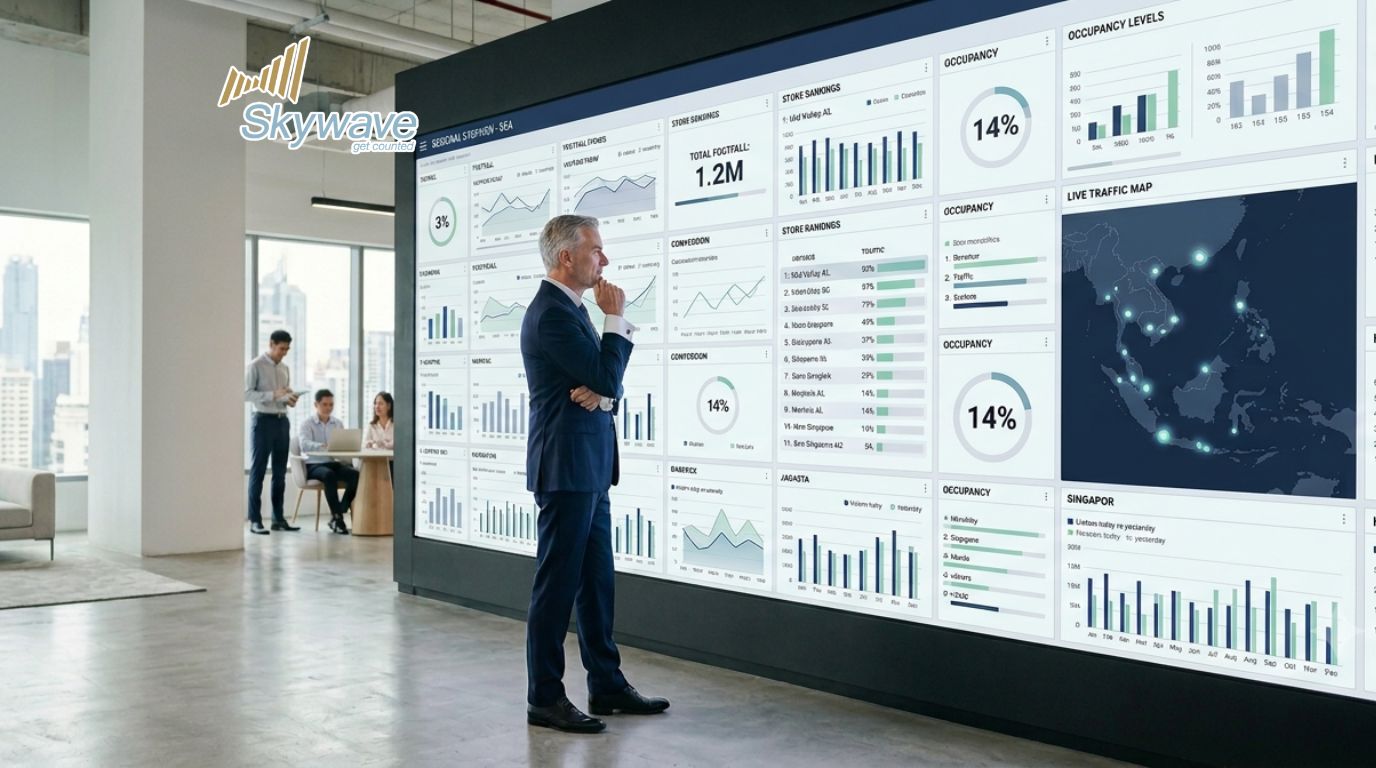
A centralized dashboard brings these insights together into a single operational view.
Regional managers can instantly monitor:
- Visitor traffic across every store
- Peak shopping hours
- Historical trends
- Store rankings
- Regional performance
- Customer flow patterns
- Operational anomalies
Instead of waiting for monthly reports, decision-makers gain near real-time visibility into the health of the entire retail network.
AI-Powered Footfall Analytics Makes the Difference
Modern AI-powered people counting systems go beyond simply counting visitors.
Advanced analytics can provide insights such as:
- Visitor trends over time
- Peak-hour analysis
- Dwell time measurement
- Occupancy monitoring
- Staff-to-visitor ratios
- Queue management
- Demographic insights such as age group and gender (where supported and deployed in compliance with local privacy regulations)
When these insights are aggregated across multiple stores, headquarters can identify patterns that would otherwise remain hidden.
The result is faster decisions, better resource allocation, and more consistent customer experience across every location.
Growth Should Increase Visibility—Not Reduce It
Ironically, many retailers become less informed as they become more successful.
Every new store introduces additional complexity.
Without the right analytics infrastructure, expansion creates more uncertainty instead of more confidence.
The most successful retail chains treat operational visibility as a competitive advantage.
They don’t simply monitor sales.
They understand customer traffic, store performance, and operational efficiency across every location.
Because when every store is connected through a unified analytics platform, headquarters can spend less time chasing reports—and more time making better decisions.
How Skywave Helps Retail Chains Scale with Confidence
For over 29 years, Skywave has helped retailers, shopping malls, attractions, and public venues turn visitor traffic into actionable business intelligence.
Our AI-powered People Counting and Footfall Analytics platform provides centralized dashboards that enable regional and headquarters teams to monitor performance across multiple locations, benchmark stores using consistent KPIs, and identify opportunities to improve operations.
Whether you’re managing 10 stores or hundreds across Southeast Asia, better visibility leads to better decisions.
Ready to gain a clearer view of your retail network?
Contact – Skywave to discover how multi-store footfall analytics can support your next stage of growth.