

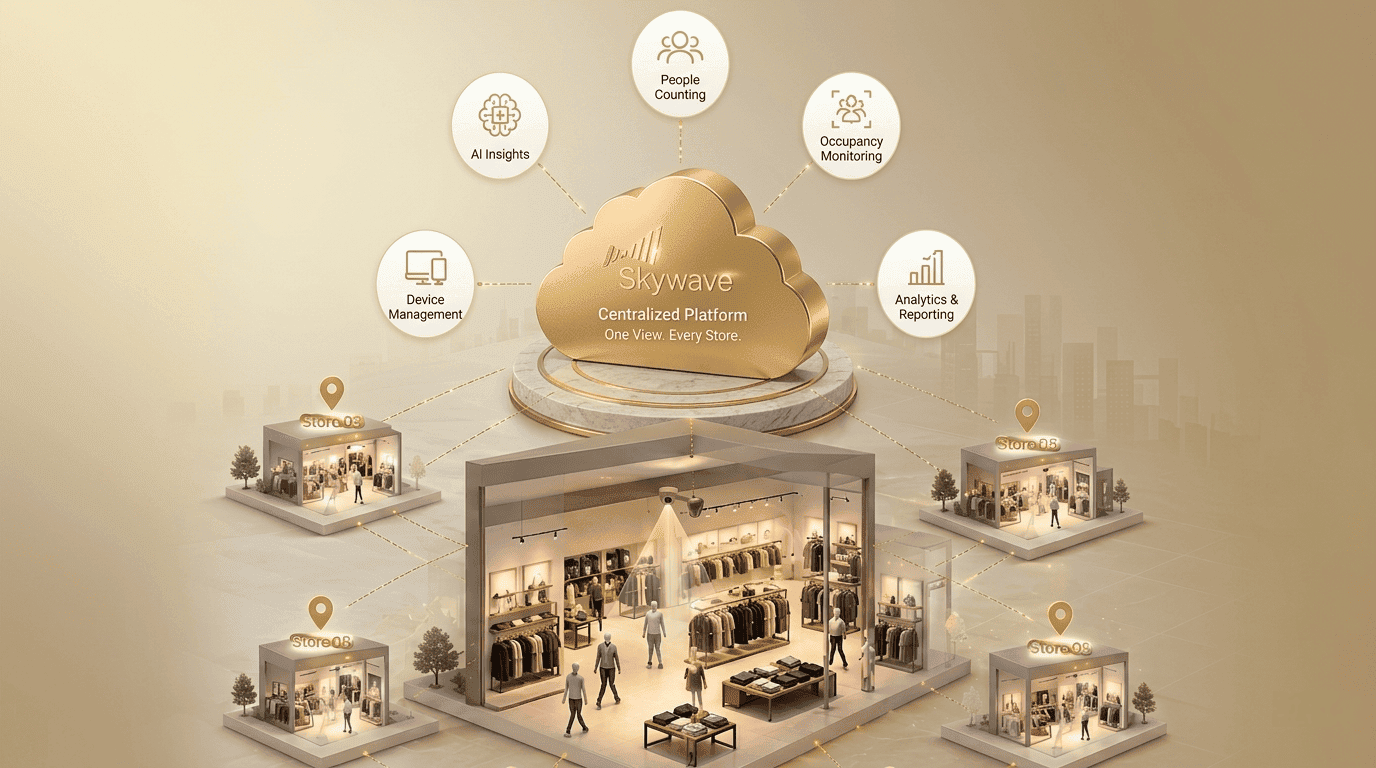
Growing from 10 stores to 100 isn’t just about opening more outlets – it’s about replicating operational excellence.
For retailers with ambitious expansion plans, success depends on more than finding the right locations. Every new store introduces another set of devices, networks, software, vendors, and operational processes that must work together seamlessly.
Without standardized technology, growth often leads to complexity rather than efficiency.
The retailers that scale successfully understand one important principle:
Standardization isn’t about limiting flexibility – it enables faster expansion, lower costs, and consistent customer experience across every location.
The Hidden Cost of Technology Inconsistency
Imagine two retail chains with 50 stores.
The first chain allowed each region to choose its own technology vendors over the years.
Some stores use different brands of people counters. Others have different CCTV systems. Wi-Fi equipment varies from store to store. Reporting dashboards look different across regions, and software versions are inconsistent.
When an issue occurs, the IT team first needs to determine what equipment the store is using before they can even begin troubleshooting.
Now consider another retailer.
Every new store follows the same technology blueprint.
The same sensors. The same network configuration. The same reporting platform. The same installation procedures.
When problems arise, support teams already know the environment. Replacement parts are readily available. Staff training is consistent.
The difference becomes more significant with every new location.
Why Technology Standards Matter
Retail technology today extends far beyond point-of-sale systems.
Modern stores rely on:
- People counting systems
- AI-powered occupancy monitoring
- CCTV and video analytics
- Digital signage
- Wi-Fi analytics
- Electronic shelf labels
- IoT sensors
- Store networking infrastructure
When every location operates differently, operational complexity increases exponentially.
Standardization creates predictable environments where every system works together consistently.
This consistency allows retailers to:
- Roll out new stores faster
- Deploy updates more efficiently
- Train employees using one standard process
- Reduce operational risk
- Generate comparable performance data across locations
Faster Troubleshooting Means Less Downtime
Technology failures are inevitable.
The difference lies in how quickly they can be resolved.
Imagine a people counting sensor stops reporting data at one store.
If every branch uses different hardware, firmware, network settings, and installation methods, diagnosing the issue becomes a lengthy investigation.
However, in a standardized environment, support teams can immediately follow proven troubleshooting procedures.
They already know:
- The hardware model
- Network architecture
- Configuration settings
- Software version
- Expected performance benchmarks
This dramatically reduces downtime.
For retailers relying on daily footfall data to evaluate marketing campaigns, staffing levels, or conversion rates, uninterrupted data collection is essential.
Lower Long-Term Costs
Many retailers mistakenly believe standardization limits supplier competition or increases upfront costs. In reality, the opposite is often true. Standardized deployments reduce total cost of ownership by lowering:
Maintenance Costs
Support teams become experts in one technology stack instead of managing dozens of different systems.
Training Costs
Employees learn one operating procedure regardless of store location.
Spare Parts Inventory
Instead of stocking replacement components for multiple vendors, retailers maintain a smaller, standardized inventory.
Deployment Costs
Each new store follows a repeatable implementation process, reducing project time and installation errors. Over hundreds of stores and several years, these savings become substantial.
Better Data Across Every Store
Retailers increasingly depend on data to guide business decisions. But data is only valuable when it is consistent.
If one store measures footfall differently from another, comparing conversion rates becomes unreliable.
Standardized people counting systems ensure that every location collects data using the same methodology, allowing retailers to compare:
- Visitor traffic
- Peak shopping hours
- Staff productivity
- Marketing campaign performance
- Conversion rates
- Regional trends
When every store speaks the same “data language,” executives gain confidence that they are making decisions based on accurate and comparable information.
Supporting Faster Expansion
Retail expansion often operates on tight timelines. Opening dozens of new stores each year requires technology that can be deployed quickly and predictably.
A standardized rollout allows retailers to create a repeatable deployment model:
- Site survey
- Equipment installation
- Configuration
- Testing
- Staff training
- Remote monitoring
Instead of reinventing the process for every new location, each opening becomes a well-practiced operation. This helps retailers expand into new cities—or even new countries – with far less operational friction.
Standardization Doesn’t Mean One-Size-Fits-All
Every retail format has unique requirements. A supermarket differs from a fashion boutique. A shopping mall differs from a convenience store.
Standardization isn’t about forcing identical technology into every environment.
Rather, it’s about defining clear technology standards within each store format, so every deployment remains consistent, secure, and easy to manage. This balance between flexibility and standardization enables retailers to innovate without creating unnecessary complexity.
Future-Proofing Retail Operations
Retail technology continues to evolve rapidly, with AI, automation, and predictive analytics becoming increasingly important.
Retailers with standardized infrastructure are far better positioned to adopt these innovations because new capabilities can be deployed across the network more efficiently.
Whether implementing AI-powered people counting, occupancy analytics, or advanced customer insights, having a consistent technology foundation reduces risk and accelerates adoption.
Final Thoughts
As retailers expand across multiple locations, operational complexity can quickly become a barrier to growth.
Standardizing retail technology creates a strong foundation for scalable operations by improving consistency, reducing downtime, lowering long-term costs, and enabling faster deployment of new stores.
For technologies like AI-powered people counting and retail analytics, standardization also ensures that decision-makers receive reliable, comparable data from every location. Growth is no longer just about opening more stores – it is about operating every store with the same level of efficiency, visibility, and performance.
At Skywave, we’ve seen first-hand how retailers that invest in standardized retail technology are better equipped to scale confidently, maintain operational excellence, and unlock greater value from the data generated across their entire store network.
Ready to standardize your retail technology? Contact – Skywave for a consultation on designing scalable people counting and retail analytics solutions that grow with your business.