

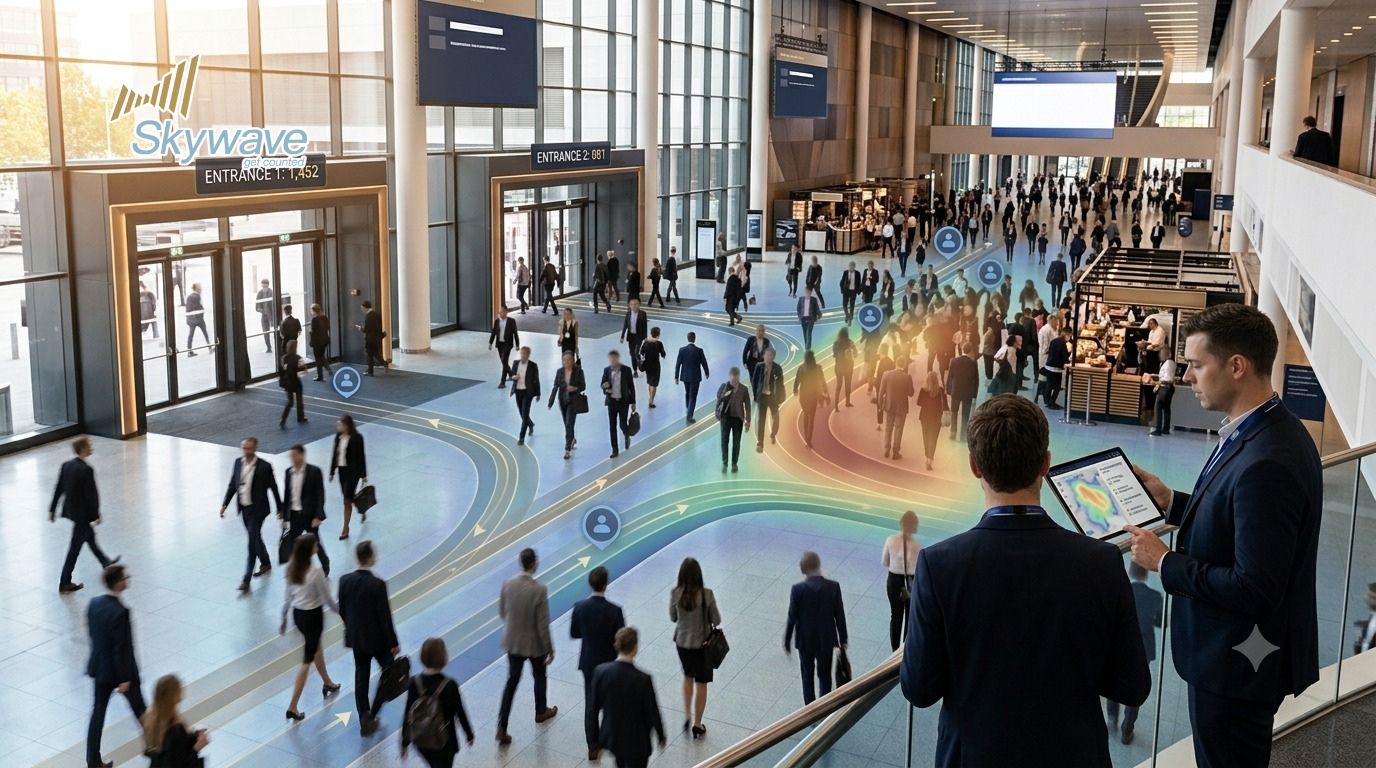
Large venues are designed to bring people together. Stadiums, convention centers, transport hubs, exhibition halls, tourist attractions, arenas, and public spaces all depend on welcoming high visitor volumes safely and efficiently.
But a successful venue is not measured by attendance alone.
The operational challenge is understanding how people arrive, where congestion forms, how long pressure points last, and how quickly teams can respond. A venue may remain within its total capacity while experiencing serious crowding at one entrance, concourse, ticketing point, lift lobby, or passageway.
This is where crowd analytics becomes essential.
By using people counting and footfall intelligence, venue operators can move beyond attendance reporting. They can identify peak periods, detect bottlenecks, improve manpower deployment, strengthen capacity planning, and create a smoother visitor experience.
The goal is not simply to count how many people entered. It is to understand how the venue is being used and turn that information into better operational decisions.
Peak Attendance Does Not Tell the Whole Story
Most large venues track total attendance, but the headline figure does not fully explain what happened during the day.
Two events with the same attendance can create very different conditions. At one event, visitors may arrive gradually over several hours. At another, most may arrive within a short 30-minute window.
The total crowd size may be similar, but the pressure on security screening, ticket validation, entrances, escalators, parking access, and customer service teams can be very different.
Venue operations teams therefore need to know:
- When visitor traffic begins to increase
- Which entrances receive the most visitors
- When arrival and departure peaks occur
- How long elevated traffic continues
- Whether crowd movement matches the operating plan
This information helps teams distinguish between a busy venue and an operationally stressed venue.
High attendance may be positive. However, a sudden concentration of visitors in one area can create delays, discomfort, safety concerns, and a poor first impression.
Why Bottlenecks Become Operational Risks
Bottlenecks occur when visitor demand exceeds the available capacity of a specific space or process.
They commonly form around entrance gates, ticket counters, bag-check areas, registration desks, turnstiles, escalators, narrow corridors, food collection points, transport pick-up zones, and exits.
Not every queue is dangerous, but unmanaged congestion can affect the wider venue.
A bottleneck at an entrance may cause crowds to spill into parking areas or public walkways. Congestion near an escalator may interrupt movement between levels. A slow security lane may create frustration before visitors even reach the main event space.
The risk often increases during:
- Opening and closing periods
- Programme changes or intermissions
- Sudden weather changes
- Transport arrival waves
- Headline performances
- Limited-time activities or promotions
Without reliable traffic data, teams may only recognize a problem after a queue has already formed.
Crowd analytics provides earlier visibility by allowing operators to monitor visitor movement against expected patterns and predefined operational thresholds.
From Counting People to Understanding Flow
Traditional people counting answers a basic question: how many people entered or exited?
Crowd analytics goes further by examining the timing, direction, and distribution of visitors across key access points.
For venue operators, this may include:
- Entry and exit volumes by time
- Traffic distribution across multiple entrances
- Peak arrival and departure windows
- Occupancy estimates for monitored areas
- Comparisons between normal and event-day patterns
- Repeated congestion at specific access points
An entrance may appear underused when looking at daily totals. However, hourly analysis may show that it becomes congested immediately before the main programme begins.
Another entrance may handle more visitors overall while maintaining a steady and manageable flow.
These differences matter when planning manpower, signage, queue barriers, screening lanes, and visitor communications.
The value is not the number alone. The value is knowing what action the number should trigger.
Real-Time Alerts Support Faster Decisions
Large venue operations depend on timing. A response that comes too late may not prevent the problem.
Real-time or near-real-time monitoring allows teams to identify unusual changes as they develop.
When visitor volumes exceed a defined threshold, one entrance becomes disproportionately busy, or occupancy approaches an operational limit, an alert can prompt the operations team to investigate.
A practical alert framework may flag:
- Rapid increases in arrival volume
- Occupancy reaching a warning level
- Unusual traffic concentration at one entrance
- Slow exit movement after an event
- Traffic patterns that differ from the operating plan
Alerts should not replace human judgement. They should provide teams with better information earlier.
Alert thresholds should reflect the venue’s layout, operating procedures, event type, staffing capacity, and historical traffic patterns. Over time, these thresholds can be refined using actual operational data rather than assumptions.
The system should also avoid generating too many unnecessary notifications. Alerts must be relevant, actionable, and connected to a clear response procedure.
Turning Alerts Into Operational Response
Data only becomes useful when it supports action.
When a potential bottleneck is detected, the venue operations team may:
- Open another entrance or screening lane
- Redirect visitors to a less congested access point
- Deploy additional security or customer service personnel
- Adjust queue barriers and pedestrian routes
- Temporarily control access to a congested area
- Coordinate with parking or transport teams
- Communicate expected delays to visitors
The correct response will depend on the venue, event, and severity of the situation. The key is to establish clear procedures before peak periods occur.
Teams should define who receives the alert, who verifies the situation, who has the authority to act, and how the response is recorded.
This turns crowd analytics into an operational workflow rather than a dashboard that is only reviewed after the event.
Better Capacity Planning Through Historical Data
Real-time visibility helps venue teams manage what is happening now. Historical analytics helps them prepare for what will happen next.
By comparing traffic patterns across different events, days, seasons, and venue configurations, operators can identify recurring behavior.
They may discover that visitors consistently arrive later than expected, one gate repeatedly receives too much traffic, or departure volumes peak faster than the existing transport plan can support.
These insights can improve:
- Staffing schedules
- Security lane requirements
- Entrance allocation
- Queue management layouts
- Cleaning and facility deployment
- Transport coordination
- Vendor operating hours
- Emergency planning
Capacity planning is not only about the maximum number of people a venue can hold. It is also about how many people each stage of the visitor journey can handle comfortably and safely.
An arena may have sufficient seating capacity, but its entrances, concourses, washrooms, food service areas, or transport connections may become the real constraint.
Crowd analytics helps operators identify these practical capacity limits.
Improve Visitor Experience, Not Just Crowd Control
Safety and operational efficiency are priorities, but better crowd flow also improves visitors’ experience.
Long queues, unclear directions, overcrowded entrances, and slow exits can negatively affect how visitors remember an event. Even when the programme itself succeeds, poor movement through the venue can reduce overall satisfaction.
With better flow intelligence, operators can open the right entrances earlier, place staff where assistance is most needed, improve directional signage, schedule activities more effectively, and reduce unnecessary waiting.
Understanding where movement slows can also support accessibility reviews for elderly visitors, families, and people with mobility needs.
Crowd analytics therefore supports both operational control and more inclusive venue planning.
Measure, Learn, and Improve Every Event
Every event creates valuable operational data. Effective venue teams use this information to review what worked, what caused pressure, and what should change next time.
A post-event review can compare:
- Expected attendance against actual arrivals
- Planned peak periods against actual peaks
- Traffic distribution across entrances
- Alert timing and operational responses
- Congestion or queue incidents
- Exit flow and transport demand
This creates a continuous improvement cycle:
Measure the crowd. Understand the flow. Respond to pressure. Refine the plan.
Over time, the venue develops a stronger operational baseline. Teams can prepare for future events with greater confidence because their decisions are supported by evidence from actual visitor behavior.
From Crowd Counting to Venue Intelligence
Large venues do not need more disconnected data. They need clear, timely information that supports safer and more efficient operations.
Skywave helps venue operators move beyond attendance counts with people counting and crowd intelligence for physical spaces.
By understanding peak hours, entrance performance, occupancy patterns, and visitor flow, operations teams can improve capacity planning, deploy resources more effectively, and respond faster when conditions change.
The result is not only better crowd control. It is a venue that is safer, more efficient, and better prepared for every event.
Contact – Skywave to explore how crowd analytics can strengthen operational visibility, capacity planning, and visitor flow across your venue.