

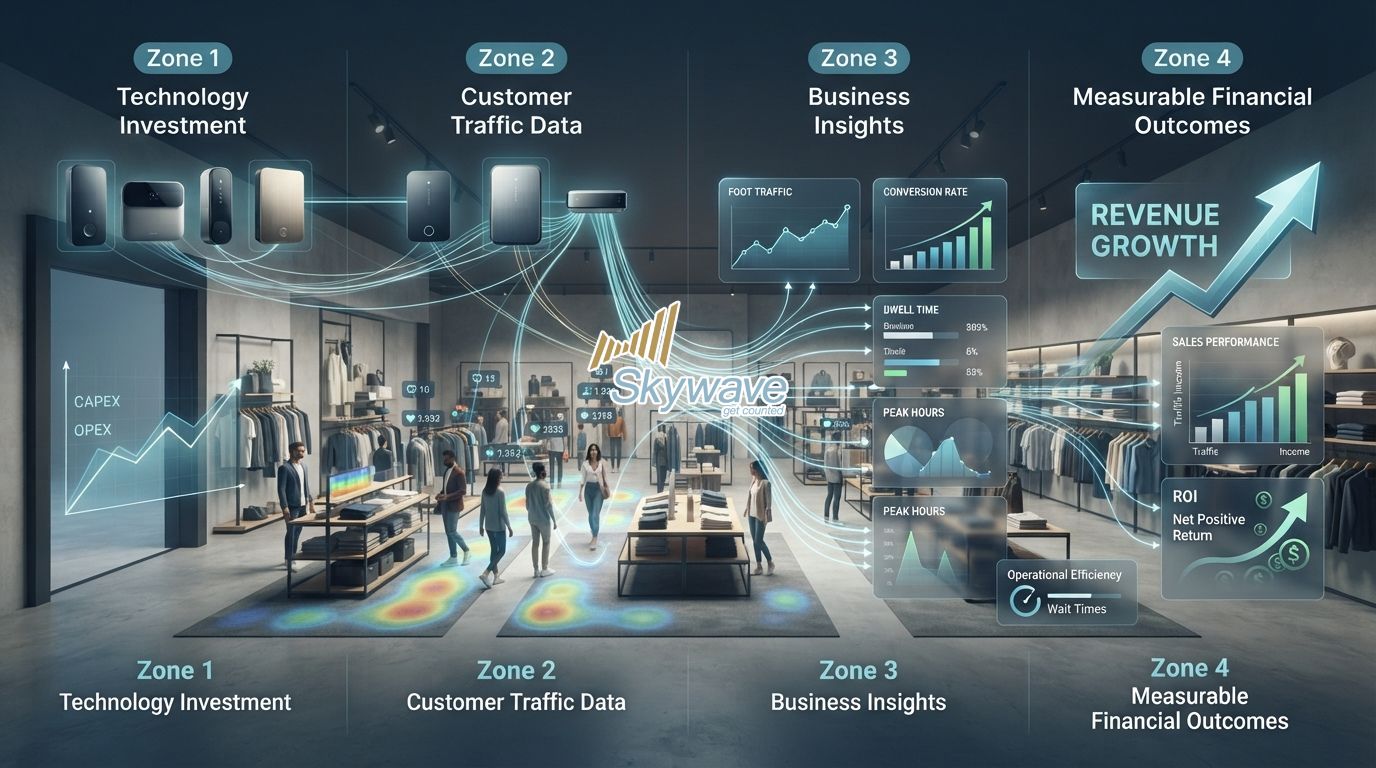
Why CFOs and management teams should stop asking, “How much does the technology cost?” and start asking, “What business decision will the data improve?”
Retail technology is no longer difficult to find. The difficult part is deciding which investments deserve budget.
For CFOs, CEOs and management teams, the question is rarely whether technology is impressive. The real question is whether it creates measurable business value.
This is especially true for retail technology such as AI-powered people counting and footfall analytics. A people counting system may look like another hardware and software expense on a budget sheet. But when the data is connected to decisions around staffing, store performance, marketing, leasing, inventory and customer conversion, it can become a tool for improving profitability.
This is the foundation of a strong Retail Growth Playbook: technology should not be sold as technology. It should be positioned to identify opportunities, reduce waste and make better commercial decisions.
The ROI story therefore needs to move through four stages:
Cost → Value → Proof → Action
1. Start With the Cost — But Don’t Stop There
Every technology investment has an obvious cost.
There may be hardware, software subscriptions, installation, maintenance, integration and internal resources involved. For a finance team, these are easy to identify and compare.
The challenge is that the benefits are often less visible.
Consider a retailer operating 50 stores.
If management knows that one store receives 10,000 visitors a month while another receives 20,000, that information alone may not seem revolutionary.
But now compare it with sales.
If Store A generates RM500,000 in monthly sales from 10,000 visitors, while Store B generates RM600,000 from 20,000 visitors, the conversation changes.
Store B generates more revenue, but Store A is converting its traffic much more effectively.
Without reliable footfall data, management may only see the sales numbers. With footfall data, they can begin to understand the relationship between traffic and sales.
That is where technology moves from being a cost to becoming a business intelligence tool.
The CFO should not simply ask:
“How much does the people counting system cost?”
The better question is:
“What decisions can we improve if we know how many people are entering each store, when they arrive, and how that traffic translates into sales?”
That is a very different investment conversation.
2. Define Value in Business Terms
ROI becomes easier to prove when technology is connected to a specific business problem.
For retailers, footfall data can support several important decisions.
- Store performance
Sales figures tell you what happened. Footfall data can help explain why.
A decline in sales could be caused by fewer visitors, lower conversion, weaker average transaction value, or a combination of factors.
For example:
Sales = Footfall × Conversion Rate × Average Transaction Value
If sales decline by 10%, management needs to know which part of this equation has changed.
If footfall fell by 15% while conversion remained stable, the problem may be traffic.
If footfall increased by 15% but sales remained flat, the opportunity may be conversion.
That distinction matters because the required action is completely different.
- Staffing optimization
Retailers often schedule staff based on historical patterns, intuition or fixed shifts.
But customer traffic is rarely evenly distributed throughout the day.
If footfall data shows that a store consistently experiences its highest traffic between 5pm and 8pm, staffing can be aligned accordingly.
The objective is not simply to reduce headcount.
It is to put the right number of employees in the store at the right time, where they have the greatest opportunity to serve customers and generate sales.
Even a small improvement in labor productivity across a large store network can create meaningful financial value.
- Marketing effectiveness
Marketing campaigns generate traffic — but did the campaign actually bring more people into the store?
This is where footfall data becomes particularly useful.
A retailer can compare store traffic before, during and after a campaign, while also comparing sales performance.
Instead of reporting:
“We spent RM100,000 on the campaign.”
Management can start asking:
“How much incremental traffic and revenue did the campaign generate?”
That creates a much stronger foundation for future budget decisions.
- Inventory and merchandising
Footfall patterns can also provide context for inventory planning.
If certain stores consistently attract higher traffic during particular periods, inventory and merchandising decisions can be adjusted accordingly.
Demographic insights, where available and used appropriately, can add another layer to the analysis.
The objective is not simply to collect more data.
It is to connect traffic → customer profile → product → sales.
That is where retail analytics begins to influence commercial decisions.
3. Choose ROI Metrics That Management Can Understand
One reason technology projects struggle to obtain budget approval is that the ROI is expressed in technology language instead of business language.
A CFO does not necessarily need to know how sophisticated the AI model is.
They need to know what financial or operational outcome they support.
Useful retail ROI metrics can include:
- Revenue per visitor
- Conversion rate
- Sales per square foot
- Footfall growth
- Labor cost per visitor
- Incremental revenue from campaigns
- Cost per visitor acquired
- Store-level productivity
- Occupancy or utilization rates
- Payback period
- Return on investment
The most important principle is to establish a baseline.
For example:
Before: 10,000 visitors → RM500,000 sales
After: 11,000 visitors → RM575,000 sales
Now management has a measurable framework for evaluating whether an initiative produced an improvement.
The numbers will vary from retailer to retailer. What matters is that the measurement framework exists.
4. Prove the Value with a Case-Style Logic
A compelling ROI story does not have to begin with a massive success story.
It can begin with a simple business hypothesis.
Imagine a retailer with 100 stores.
Management discovers that the bottom 20 stores have significantly lower traffic than the network average.
Instead of immediately closing those stores, the retailer investigates.
Footfall data shows that several locations have good traffic but weak conversion.
That suggests a different problem.
Management can then test interventions such as staffing, merchandising, promotions or store layout.
Other stores may have the opposite problem: strong conversion but declining traffic.
Those stores may require a marketing or location strategy rather than a sales-floor intervention.
This is the power of data.
The people counting system itself does not create the ROI.
The decisions made from the data create the ROI.
This distinction is critical when presenting technology investments to management.
The business case should therefore look something like this:
- Problem: Management cannot clearly distinguish traffic problems from conversion problems.
- Data gap: Sales are measured, but store traffic is not consistently measured.
- Technology: Deploy people counting and footfall analytics.
- Insight: Identify traffic patterns and benchmark stores against one another.
- Action: Optimize staffing, campaigns, merchandising or store strategy.
- Outcome: Measure the change against the original baseline.
- ROI: Quantify the financial impact relative to the technology investment.
That is a much stronger story than simply saying, “Our system counts people accurately.”
5. Think of Footfall Data as a Management Layer
The most valuable technology investments are those that become part of the management process.
For a retailer, this could mean incorporating footfall into weekly store performance reviews.
Instead of reviewing only:
Sales | Gross Margin | Transactions
management reviews:
Footfall | Conversion | Transactions | Average Basket | Sales
Now the sales number has context.
A store manager who misses sales targets can investigate whether the issue is traffic or execution.
A regional manager can benchmark stores more intelligently.
Marketing can evaluate whether campaigns generate physical visits.
Operations can understand peak periods.
Finance can evaluate whether investment is producing measurable returns.
The technology becomes part of the retailer’s operating system rather than another standalone dashboard.
6. The CFO’s ROI Question: “How Quickly Does It Pay Back?”
Ultimately, every investment needs financial justification.
A simple payback model can help.
Suppose a retailer invests RM120,000 in a footfall analytics program.
If better staffing, improved campaign measurement and store-performance optimization contribute to RM20,000 of measurable incremental value per month, the theoretical payback period is six months.
The actual calculation will depend on the retailer’s baseline, implementation cost and measured outcomes.
But the principle is universal:
Investment ÷ measurable monthly benefit = approximate payback period
The more clearly the business can attribute benefits to specific actions, the stronger the investment case becomes.
This is why the implementation process matters as much as the technology.
A retailer should define the KPIs before deployment, establish the baseline, identify the decisions the data will influence, and review the results after implementation.
7. From “Technology Expense” to “Growth Infrastructure”
Skywave has spent decades working with organizations that use people counting technology across retail, shopping malls, theme parks, stadiums and other high-traffic environments.
With a track record built over 30 years, including long-standing customers in Singapore, the lesson is straightforward:
Reliable data becomes more valuable when it is embedded into business decisions.
A system with hundreds of sensors can produce millions of data points. But the real value is not the number of sensors or data points.
It is the ability to turn that data into answers to questions such as:
- Which stores are underperforming because of low traffic?
- Which stores have strong traffic but weak conversion?
- When should staffing levels increase?
- Did a marketing campaign drive store visits?
- Which locations are becoming more or less productive?
- Where should management investigate further?
Those are management questions, not technology questions.
And that is precisely how the ROI conversation should evolve.
The Final Test: Can You Explain the ROI in One Sentence?
Before approving any retail technology investment, management should be able to complete this sentence:
“We are investing RM___ because we expect the data to help us improve, resulting in approximately RM of measurable value within ___ months.”
If that sentence cannot be completed, the business case may not yet be strong enough.
But if it can — and the organization has a clear baseline, measurable KPIs and a process for acting on the insights — technology becomes much easier to justify.
The strongest retail technology investments are not necessarily the ones with the most advanced features.
They are the ones where management can clearly connect:
Cost → Data → Decision → Action → Financial Outcome
That is how retailers move from buying technology to investing in growth.
Ready to Build the Business Case?
If your organization is considering people counting or footfall analytics, start with the business problem rather than the technology.
Identify the decisions that need better data. Establish your current baseline. Define the KPIs that matter. Then calculate what even a small improvement could mean across your store network.
Skywave can help you evaluate the opportunity and build a business case around measurable retail outcomes — not just sensor installation.
Because the question is not: “Can technology count our visitors?”
It is: “What could we improve if we finally knew what our visitors were telling us?”