

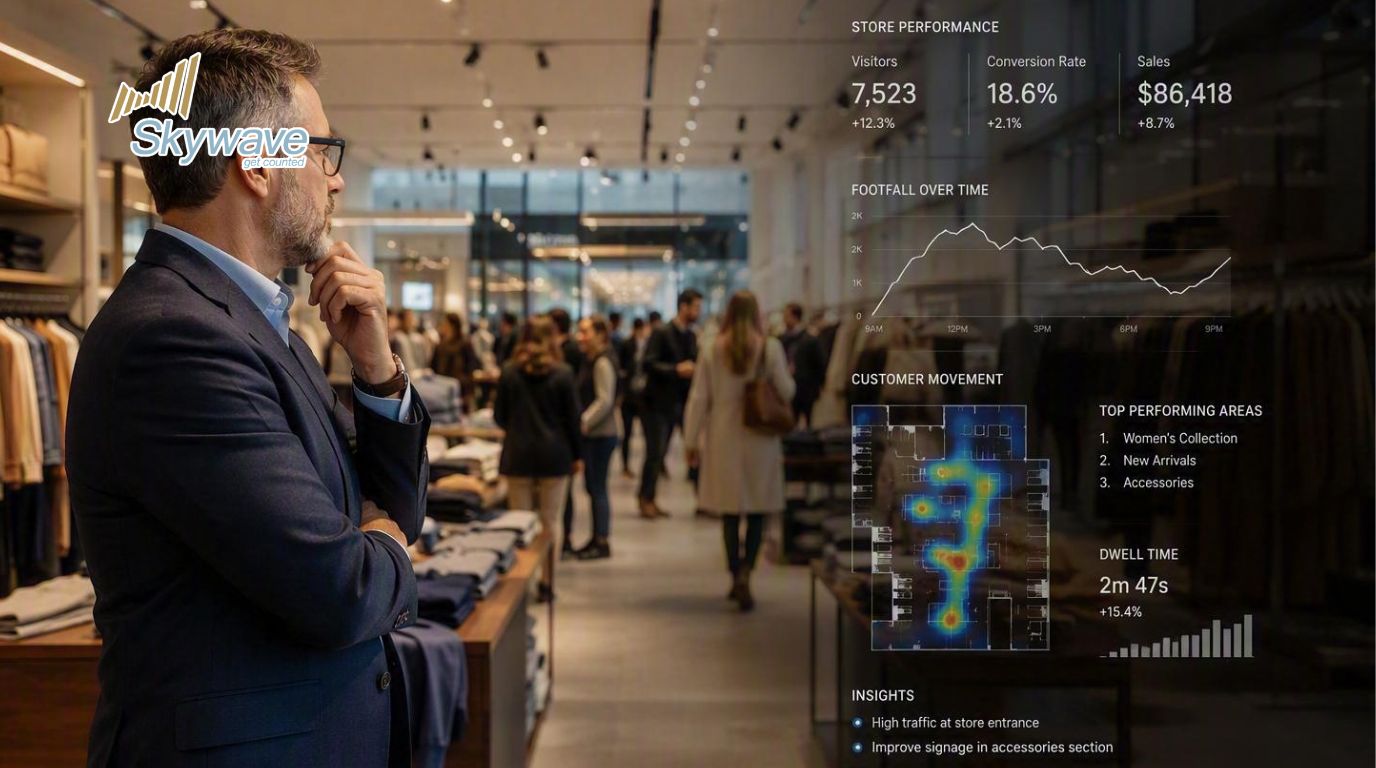
For decades, retail has been a business built on instinct.
A store manager walks the floor and knows when the store feels busy. A regional manager visits several outlets and develops a sense of which locations are performing well. A merchandising team knows which products “seem to be moving.” A retailer might even look at sales reports at the end of the month and conclude that a particular store had a good or bad period.
Experience matters. In retail, it always will.
But the way retailers make decisions is changing.
Today, the most successful retail organizations are beginning to ask a different set of questions:
How many people actually visited the store?
When did they visit?
Which areas did they spend time in?
What happened to traffic when we changed the layout, promotion or opening hours?
And perhaps most importantly:
What can we learn from customer behavior that our sales numbers alone cannot tell us?
This represents more than the adoption of another technology. It represents a cultural shift in retail—from decisions based primarily on intuition to decisions increasingly supported by evidence.
The future of retail will not be intuition versus data.
It will be intuition enhanced by data.
The Old Retail Decision-Making Model
Retail leaders have always worked with data.
Sales, transactions, inventory, margins and customer feedback are hardly new concepts. The challenge is that many of these metrics tell retailers what happened after the customer made a purchase.
For example, a store generates RM100,000 in sales this month.
That number is important—but it does not tell the whole story.
Was the store busy?
Did 20,000 people walk past the entrance but only 5,000 enter?
Did traffic increase by 15% but sales increase by only 3%?
Did customers spend more time in the store but purchase less?
Did a new campaign generate additional visitors—or simply shift existing customers from one day to another?
Traditionally, retail leaders have had to fill these gaps with experience and assumptions.
A store manager might say: “Footfall seems lower this month.”
A regional manager might respond: “I think the mall has been quieter.”
A marketing team might conclude: “The campaign didn’t perform.”
These statements may be correct. But they are still hypotheses.
The problem is not that intuition is wrong. The problem is that intuition is difficult to measure, compare and scale.
One manager’s “busy” may be another manager’s “normal.”
One retailer’s perception of a successful promotion may differ from another’s.
And when a business has 20, 50 or 200 stores, relying on individual observations becomes increasingly difficult.
The New Question: What Is Actually Happening?
This is where retail intelligence begins.
AI-powered people counting provides one of the most fundamental pieces of information in the retail environment: how many people are actually coming into your stores.
But counting people is only the beginning.
Once traffic data is collected consistently, retailers can begin to understand patterns.
They can compare:
- Store traffic versus sales
- Weekday versus weekend performance
- Hourly traffic patterns
- Campaign periods versus normal periods
- Different stores within the same region
- Different locations within the same mall
- Traffic trends over time
- Entrance traffic versus actual store entry
- Customer movement across different zones
- Dwell time and queue behavior
This changes the conversation.
Instead of asking, “Why are sales down?”, a retailer can begin by asking:
“Did fewer people visit, or did we become less effective at converting the people who visited?”
That distinction is enormously important.
If traffic has fallen, the business may need to investigate marketing, location, mall traffic, seasonality or external factors.
If traffic has increased but sales have remained flat, the problem may be somewhere else: conversion, merchandising, pricing, staffing, customer experience or product availability.
The data does not necessarily provide the answer immediately.
But it tells you where to look.
That is the difference between a dashboard and an insight.
The Retail Data Maturity Curve
Not every retailer is at the same stage of this journey.
In our view, retail organizations tend to move through a data maturity curve.
Stage 1: Intuition
At the beginning, decisions are primarily driven by experience.
Store managers know their customers. Regional managers know their locations. Leaders rely heavily on what they see, hear and feel.
This can work—especially for smaller businesses.
But as the organization grows, intuition becomes increasingly difficult to scale.
Stage 2: Measurement
The retailer starts collecting operational data.
Sales, transactions, inventory and perhaps customer feedback become more structured.
The business can now answer: “What happened?”
But it may still struggle to answer: “Why did it happen?”
Stage 3: Retail Intelligence
This is where behavioral data starts entering the picture.
Footfall, customer movement, dwell time, queue patterns, zone performance and other behavioral indicators provide a view of what customers are doing inside and around the store.
The business begins to understand: “What are our customers actually doing?”
This is a critical shift. Sales data tells you about the transaction.
Retail intelligence helps you understand the shopper behavior behind the transaction.
Stage 4: Business Intelligence
The next step is connecting customer behavior with business performance.
Traffic can be analyzed alongside sales, conversion, staffing, promotions and other business indicators.
Now the retailer can begin by asking: “What actions can improve performance?”
This is where data becomes much more than reporting.
It becomes a decision-making system.
From Counting People to Understanding People
This is also why the conversation around people counting needs to evolve.
For years, the technology was often positioned simply as a way to answer:
“How many people came into my store?”
That is useful—but it is only the foundation.
The more important question is:
“What can we learn about our customers from their behavior?”
A retailer may discover that one store receives significantly higher traffic between 6pm and 8pm.
That could influence staffing.
Another store may have strong traffic but unusually low conversion.
That could trigger an investigation into merchandising or customer experience.
A campaign may generate a substantial increase in traffic but very little additional revenue.
That could change how marketing ROI is evaluated.
A store layout may be redesigned, and traffic patterns can be measured before and after the change.
Suddenly, the retailer is no longer simply collecting numbers.
It is learning from the physical behavior of customers.
This is the foundation of Retail Intelligence.
And Retail Intelligence is only one part of the larger opportunity.
The Next Step: From Insight to Growth
The ultimate purpose of data is not to produce more reports.
It is to make better decisions.
This is the principle behind the Retail Growth Playbook.
We see the journey as a progression:
Attract → Measure → Understand → Optimize → Protect
Attract customers through better experiences and marketing.
Measure customer traffic with AI-powered people counting.
Understand shopper behavior through Retail Intelligence.
Optimize business performance by connecting behavioral insights with sales and operational data.
Protect the retail environment through appropriate security and operational intelligence.
The objective is simple: Grow every store.
This changes the role of technology within retail.
Technology is no longer simply an IT investment.
It becomes part of the commercial decision-making infrastructure of the business.
Data Does Not Replace Experience
There is an important misconception to address.
Becoming data-driven does not mean removing human judgement.
Retail is still a people business.
Experienced retail leaders understand their customers, employees, locations and markets in ways that no dashboard can completely capture.
The opportunity is to combine that experience with evidence.
Imagine a store manager saying: “I think our evening traffic has changed.”
Instead of stopping there, the organization can look at the data.
Or a regional manager says: “This store should be performing better than the others.”
The business can compare traffic, conversion and other performance indicators.
Or a marketing team believes a campaign increased store visits.
The retailer can measure whether that actually happened.
The cultural shift is therefore not from people to data.
It is from opinion alone to informed judgement.
The best decisions will increasingly come from combining the two.
The Competitive Advantage Will Be How Fast You Learn
As retail becomes more competitive, having data will not necessarily be enough.
The real advantage will come from how quickly an organization can turn data into action.
Two retailers may have access to similar technology.
One uses it to produce monthly reports.
The other uses it to identify underperforming stores, test changes, measure results and continuously improve.
The difference is not the technology. It is the culture of learning built around it.
This is why data maturity is ultimately a leadership issue.
Retail leaders need to create organizations where teams are encouraged to ask questions, test assumptions and learn from evidence.
Instead of: “This store is busy.”
Ask: “Busy compared with what?”
Instead of: “The promotion worked.”
Ask: “What changed because of the promotion?”
Instead of: “This location is underperforming.”
Ask: “Is the problem traffic, conversion, customer experience—or something else?”
Better questions lead to better decisions.
And better decisions create better-performing stores.
The Future of Retail Is More Measurable
The physical store is not disappearing.
In fact, as retailers compete across physical and digital channels, the ability to understand what happens inside the physical environment becomes increasingly valuable.
The store is a living environment.
Customers enter, browse, move, pause, queue, interact and leave.
Until relatively recently, much of this behavior was invisible.
Today, AI and computer vision are making more of it measurable.
The opportunity is not simply to count every visitor.
It is to turn previously invisible customer behavior into useful intelligence—and then connect that intelligence to business outcomes.
That is the journey from counting people to understanding people.
And ultimately, from understanding people to growing businesses.
A New Retail Question
The retailers that thrive in the coming years may not necessarily be those with the most data.
They will be the ones that know how to ask better questions of their data.
Because the real transformation is not technological.
It is cultural. It is the shift from: “I think…”
To “The data shows…” and eventually to: “We tested it, we learned, and we know what to do next.”
That is the future of retail decision-making.
For retail leaders, the question is no longer whether data should influence decisions.
The question is: How much of your retail business is still invisible to you?
The journey from intuition to insight starts by making that invisible behavior measurable.
And that is where the next generation of retail growth begins.
The next generation of retail leaders won’t just ask what happened. They’ll know why.
Start your journey from intuition to insight with Skywave, Contact – Skywave.