

Retail has never had more data.
Retailers can measure transactions, customer traffic, marketing performance, inventory, staffing, digital engagement and increasingly, what shoppers do inside physical stores. Shopping malls can measure visitor traffic, tenant performance, campaign response, parking utilization and movement across different zones.
Yet having more data does not necessarily mean making better decisions.
The next five years of retail analytics will be less about collecting more data and more about turning data into decisions.
Artificial intelligence will change retail analytics from a system that tells executives what happened into one that helps them understand why it happened, what is likely to happen next, and what they should do about it.
For physical retail, this evolution is particularly significant. People counting and footfall analytics have traditionally answered a relatively simple question: How many people came through the door?
The next generation of retail intelligence will go much further.
It will connect footfall, shopper behavior, demographics, dwell time, movement patterns and sales performance to create a more complete picture of physical retail performance.
The winners will not necessarily be the businesses with the most data.
They will be the businesses that can act on it fastest.
From Counting Traffic to Understanding Performance
For decades, people counting has been one of the most fundamental measurements in physical retail.
Footfall provides context for almost every other retail metric.
If sales increase, was it because more people visited the store—or because the store converted more visitors into customers?
If sales decline, is the problem lower traffic, weaker conversion, poor merchandising, staffing, or something else?
If a shopping mall sees higher visitor numbers, are those additional visitors actually benefiting tenants?
This is where retail analytics is evolving.
The traditional approach has been:
Measure → Report → Review → Decide
The emerging model is:
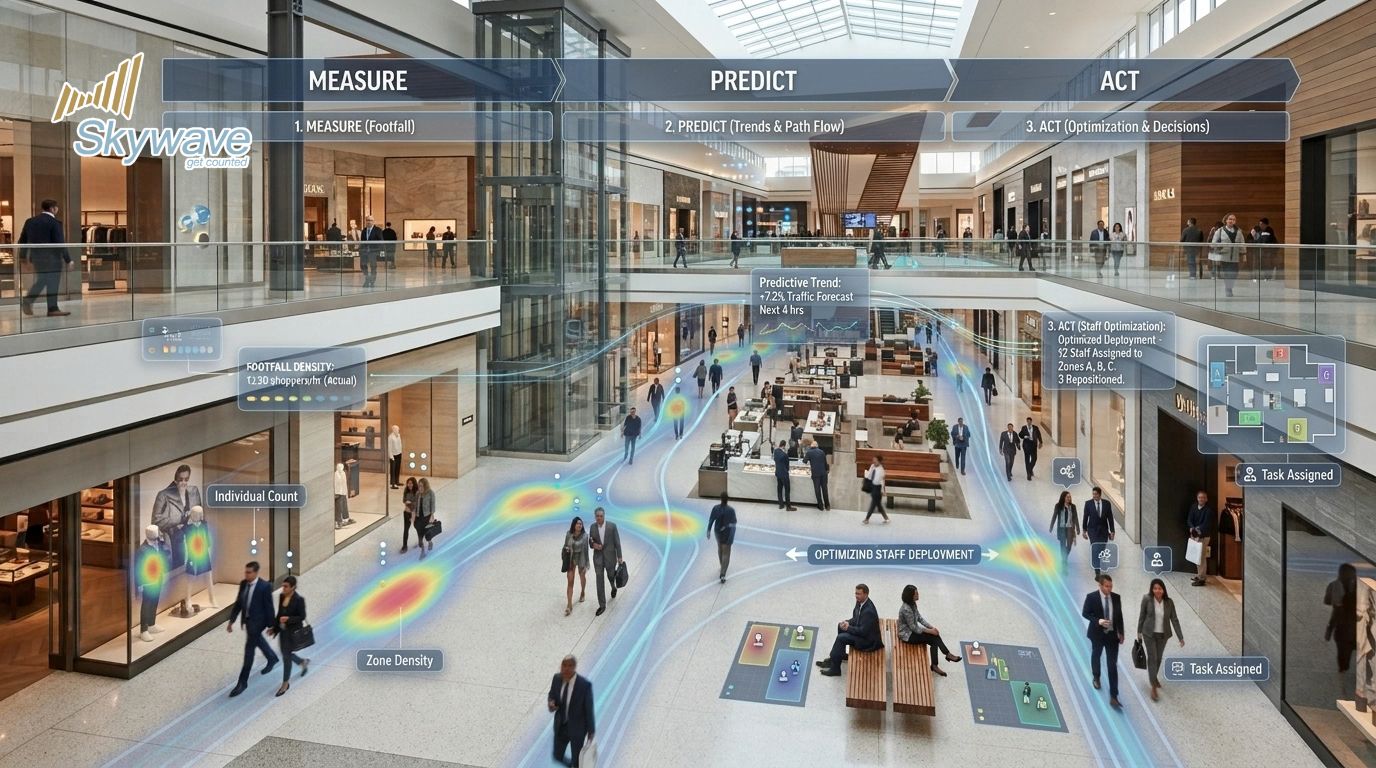
Measure → Understand → Predict → Recommend → Act
AI-powered people counting and footfall analytics provide the foundation for this transition.
Instead of looking at visitor numbers in isolation, businesses can begin connecting traffic with other operational and commercial data to understand the relationship between visitors, behavior and business outcomes.
That shift will become increasingly important over the next five years.
1. AI Will Move Analytics from Reporting to Interpretation
The first major change will be the way executives interact with data.
Today, many retail dashboards still require users to interpret charts, compare periods, identify anomalies and determine what matters.
AI will increasingly perform much of that analytical work automatically.
Instead of presenting an executive with a dashboard showing that footfall dropped 12%, an intelligent analytics platform could identify:
- Footfall declined primarily during weekday afternoons.
- The decline was concentrated in a specific store or mall zone.
- Similar locations experienced a smaller decline.
- The change coincided with a campaign or operational adjustment.
- Sales declined less than footfall, suggesting conversion may have improved.
- The pattern is likely to continue unless conditions change.
The dashboard becomes less important than the insight behind the dashboard.
This is a fundamental change in the role of analytics.
Executives should not have to become data analysts simply to understand their own business.
AI will increasingly act as an analytical layer between raw data and management decisions.
2. Predictive Analytics Will Become More Important Than Historical Reporting
Traditional retail reporting is inherently backward-looking.
Last week we had 125,000 visitors.
Last month sales were 8% higher.
This year’s footfall was lower than last year’s.
These numbers are useful—but they describe the past.
The next generation of analytics will increasingly focus on what happens next.
Predictive models can identify patterns across historical footfall, seasonality, day of week, holidays, campaigns, weather, events and other business variables.
For retailers, this could support questions such as:
What is likely to happen to store traffic next weekend?
Which stores are likely to underperform?
When will staffing demand be highest?
Which locations show signs of declining performance?
For shopping malls:
What visitor traffic should we expect during a major campaign?
Which zones are likely to receive the most traffic?
Which tenants are benefiting from increased mall traffic?
Where are these opportunities to improve visitor circulation?
The important point is that predictive analytics does not replace management judgement.
It gives management better information before making the decision.
That can be particularly powerful in environments where small improvements in conversion, staffing or tenant performance can have a significant financial impact.
3. Retail Analytics Will Become More Connected
One of the biggest limitations of traditional analytics is that important information often sits in separate systems.
Footfall data may exist in one platform.
POS data in another.
Marketing data somewhere else.
Staff scheduling in another system.
Customer feedback somewhere else again.
The future of retail analytics will be increasingly about connecting these datasets.
Consider a simple example.
A retailer sees that Store A receives 20,000 visitors per month but generates significantly less revenue than Store B, which receives similar traffic.
Footfall alone cannot explain the difference.
But when footfall is combined with sales data, conversion can be estimated.
When demographic and behavioral insights are added, management may discover differences in shopper profiles.
When dwell time and zone movement are considered, another pattern may emerge.
Suddenly, the question is no longer:
“How much traffic does this store get?”
It becomes:
“How effectively does this store turn available traffic into business performance?”
This is the shift from Retail Intelligence to Business Intelligence.
Retail Intelligence helps businesses understand shopper behavior.
Business Intelligence helps executives understand what that behavior means for performance.
The next five years will increasingly bring these two together.
4. Automation Will Turn Insights into Actions
The most valuable analytics system may ultimately be the one that requires the least manual analysis.
Today, teams spend considerable time preparing reports, downloading data, comparing periods and creating presentations.
Automation will increasingly take over these repetitive activities.
Imagine a system automatically identifying that a store’s traffic has fallen significantly against its normal pattern.
Instead of waiting for a monthly review, the system could alert the relevant manager.
It could provide context:
Traffic is down 15% versus the expected level. The decline is concentrated between 5pm and 8pm. Nearby stores are not experiencing the same pattern.
The next stage is even more powerful.
The system could recommend potential actions:
Consider reviewing staffing levels, current promotions and entrance visibility during the affected period.
This is where AI moves from being an analytical tool to becoming an operational decision-support layer.
The objective is not to automate management.
It is to automate the work that prevents management from focusing on the decisions that matter.
5. Executives Will Shift from Dashboards to Questions
Perhaps the most visible change will be how executives consume analytics.
Instead of navigating multiple dashboards, executives will increasingly interact with data through natural language.
A CEO could ask:
“Which stores are performing below their potential?”
A retail director might ask:
“What changed in our traffic and conversion this month?”
A mall management team could ask:
“Which zones are underperforming, and what factors appear to be driving the decline?”
The system can then analyze the relevant data and present the answer.
This is important because executive analytics should not be about giving leaders more information.
It should be about giving them better answers to important business questions.
What This Means for Retailers and Shopping Malls
For retailers, the opportunity is to move beyond simply measuring store traffic.
The real opportunity is to understand the relationship between traffic, shopper behavior and revenue.
That can support better decisions around store performance, staffing, marketing, merchandising, location benchmarking and expansion.
For shopping malls, the opportunity is equally significant.
Visitor traffic has traditionally been one of the most important indicators of mall performance. But the future will require a deeper understanding of where visitors go, how long they stay, which zones attract them, how campaigns influence behavior and how effectively traffic translates into tenant performance.
This creates a broader concept of mall performance intelligence.
The objective is no longer simply to increase the number of people entering a mall.
It is to understand how visitor traffic contributes to tenant success, customer experience and ultimately asset value.
The Real Competitive Advantage: Turning Data into Decisions
Technology will continue to evolve rapidly over the next five years.
AI models will become more capable.
Computer vision will become more accurate.
Data integration will become easier.
Predictive analytics will become more accessible.
Automation will become increasingly sophisticated.
But technology itself will not create competitive advantage.
The advantage will come from how effectively a business uses technology to improve decisions.
This is why the evolution of people counting matters.
What began as a relatively simple way to measure visitor numbers is becoming the foundation for a much broader performance intelligence ecosystem.
The journey can be viewed simply:
People Counting → Footfall Analytics → Retail Intelligence → Business Intelligence → Executive Insights → Business Growth
The end goal is not more dashboards.
It is better business performance.
The Next Five Years Will Belong to Intelligent Retail
The retail leaders of the next five years will increasingly ask different questions.
Not simply:
“How many visitors did we have?”
But:
“What does our traffic tell us about the health of the business?”
Not simply:
“What happened last month?”
But:
“What is likely to happen next?”
And ultimately:
“What should we do now?”
That is where retail analytics is heading.
At Skywave, we believe AI-powered people counting and footfall intelligence will remain an essential foundation for this evolution—but the opportunity goes far beyond counting people.
The future is about connecting physical-space data with business performance to help retailers and shopping malls understand, optimize and grow.
The next generation of retail analytics will not simply tell businesses what happened.
It will help them see what is coming—and act on it.
The question is no longer whether retailers and malls will use AI in their analytics. The question is how quickly they can turn that intelligence into measurable business growth.
If your organization is ready to move from measuring footfall to understanding performance, talk to Skywave about building your next generation of Retail Performance Intelligence.