

Why Data-Driven Retailers Will Outperform in Uncertain Markets
For retail leaders, uncertainty is no longer an occasional challenge. It is becoming part of the operating environment.
Consumer behavior changes quickly. Costs remain under pressure. Competition is intensifying, both online and offline. Marketing campaigns can produce unpredictable results, while the same store can perform very differently from one week, month, or location to another.
In this environment, retailers do not necessarily need more data.
They need better intelligence from the data they already have.
The retailers that build this capability will be better positioned to respond to changing conditions, identify problems earlier, allocate resources more effectively, and turn opportunities into action.
This is where data-driven retail moves beyond dashboards and reporting.
It becomes a competitive capability.
Uncertainty Changes the Rules of Retail
In a stable market, retailers can sometimes rely on experience and historical patterns.
A store has always performed well during a particular period. A particular promotion has always generated traffic. A particular location has always been considered a strong performer.
But when consumer behavior becomes less predictable, yesterday’s assumptions become less reliable.
A store may experience lower traffic without management immediately knowing why.
Another store may have healthy footfall but disappointing sales.
A campaign may generate thousands of visitors but little incremental business.
A high-traffic location may appear successful while another lower-traffic store is actually converting visitors more effectively.
These situations highlight an important distinction:
Activity is not the same as performance.
Footfall tells retailers how many people entered a store. Sales tell them what was purchased.
But the most important management question is often:
What happened between those two points?
That is where retail intelligence begins.
The Data Edge: Knowing What Is Actually Happening
Retailers already have access to multiple sources of information: point-of-sale data, inventory, promotions, staffing, customer feedback, digital marketing performance and, increasingly, footfall data.
The opportunity is to connect these signals.
Consider a simple retail equation:
Revenue = Visitors × Conversion Rate × Average Basket Value
If sales decline, the answer is not necessarily to attract more people.
Perhaps visitor numbers have fallen.
Perhaps traffic is healthy, but conversion has dropped.
Perhaps conversion remains stable, but customers are spending less.
Each situation requires a different management response.
Without visibility into the different components, management may respond to the wrong problem.
For example, increasing marketing spend may appear logical when sales are falling. But if the real issue is poor conversion inside the store, generating more traffic may simply generate more visitors who do not buy.
Likewise, reducing staffing because sales are weak may create another problem if insufficient staff are available during peak traffic periods.
The counter tells us what happened. Intelligence helps us ask why.
That distinction becomes particularly important when markets are uncertain.
Faster Decisions Become a Competitive Advantage
In uncertain markets, the advantage is not simply having more information.
It is being able to move from information to action faster.
Traditional retail reporting often looks backwards.
At the end of the month, management reviews sales.
At the end of a campaign, marketing reviews results.
At the end of the quarter, management compares store performance.
These reports remain useful. But by the time an issue becomes visible, the opportunity to respond may already have passed.
Data-driven retailers increasingly move toward a continuous cycle:
Measure → Understand → Diagnose → Act → Measure Again
The objective is not to create another report.
It is to shorten the distance between an observation and a management decision.
Imagine a retailer sees that Store A has significantly higher footfall than Store B.
That is an observation.
The next questions are more valuable:
- Is Store A converting more visitors?
- Is Store B receiving enough traffic?
- Are peak periods aligned with staffing?
- Are customers spending differently between locations?
- Is one store benefiting from a stronger surrounding tenant mix?
- Did a recent campaign change visitor behavior?
- Is the problem of traffic, conversion, basket size—or a combination?
Once these questions can be answered using connected data, management can move from reporting performance to managing performance.
From People Counting to Retail Intelligence
People counting has traditionally been treated as a relatively simple operational metric.
How many people entered?
How many people exited?
What was the traffic trend?
These remain important questions.
But modern AI-powered people counting can provide the foundation for a much broader intelligence layer.
Footfall can be analyzed alongside:
- Store sales
- Conversion rates
- Passerby traffic
- Visitor patterns
- Dwell time
- Peak periods
- Queue activity
- Zone traffic
- Campaign activity
- Store productivity
- Sales per visitor
This creates a more complete picture of what is happening inside and around a retail environment.
For a retailer with multiple locations, the value becomes even greater.
Instead of looking at each store independently, management can benchmark locations against one another.
One store may have high traffic but low conversion.
Another may have lower traffic but significantly stronger sales productivity.
A third may have strong weekend performance but weak weekday utilization.
These differences create opportunities for management to investigate, learn and replicate what works.
The Retail Growth Playbook: From Traffic to Growth
This is the foundation of the Retail Growth Playbook we have been developing for Skywave.
The journey is not simply:
Count → Report
It is:
Attract → Measure → Understand & Optimize → Protect → Repeat, Refine & Grow
The first step is understanding the traffic entering the retail environment.
The second is measuring what happens to that traffic.
The third is using the data to identify opportunities for improvement.
The fourth is protecting the operation through better visibility into issues such as crowding, queues and operational performance.
And finally, the cycle repeats.
Every improvement creates another learning opportunity.
This matters because retail growth is rarely the result of one major decision.
More often, it comes from making many smaller decisions better:
Which stores need attention?
Which periods need more staffing?
Which campaigns are actually changing behavior?
Where is conversion underperforming?
Which locations have the best transferable practices?
Where should management investigate further?
Data does not make these decisions automatically.
It gives retail leaders a stronger basis for making them.
The Competitive Advantage of Benchmarking
One of the most powerful applications of retail intelligence is benchmarking.
A retailer with 50 stores may already have 50 sources of operational learning.
The challenge is extracting that learning.
Why does one location consistently outperform another?
Is it the location?
The customer profiles?
The store team?
The product mix?
The surrounding traffic?
The campaign strategy?
The operating hours?
Without comparable data, these questions can become matters of opinion.
With consistent measurement, they become questions that can be investigated.
This is particularly valuable for regional retailers operating across Malaysia, Singapore, Indonesia, Thailand and other markets where consumer behavior and retail environments can differ significantly.
The goal is not to make every store identical.
It is to understand why performance differs.
That knowledge allows management to make more informed decisions about expansion, staffing, marketing, store formats and resource allocation.
The Same Principle Applies to Shopping Malls
The data-driven approach does not stop at the individual store.
Shopping mall operators face their own version of the same challenge.
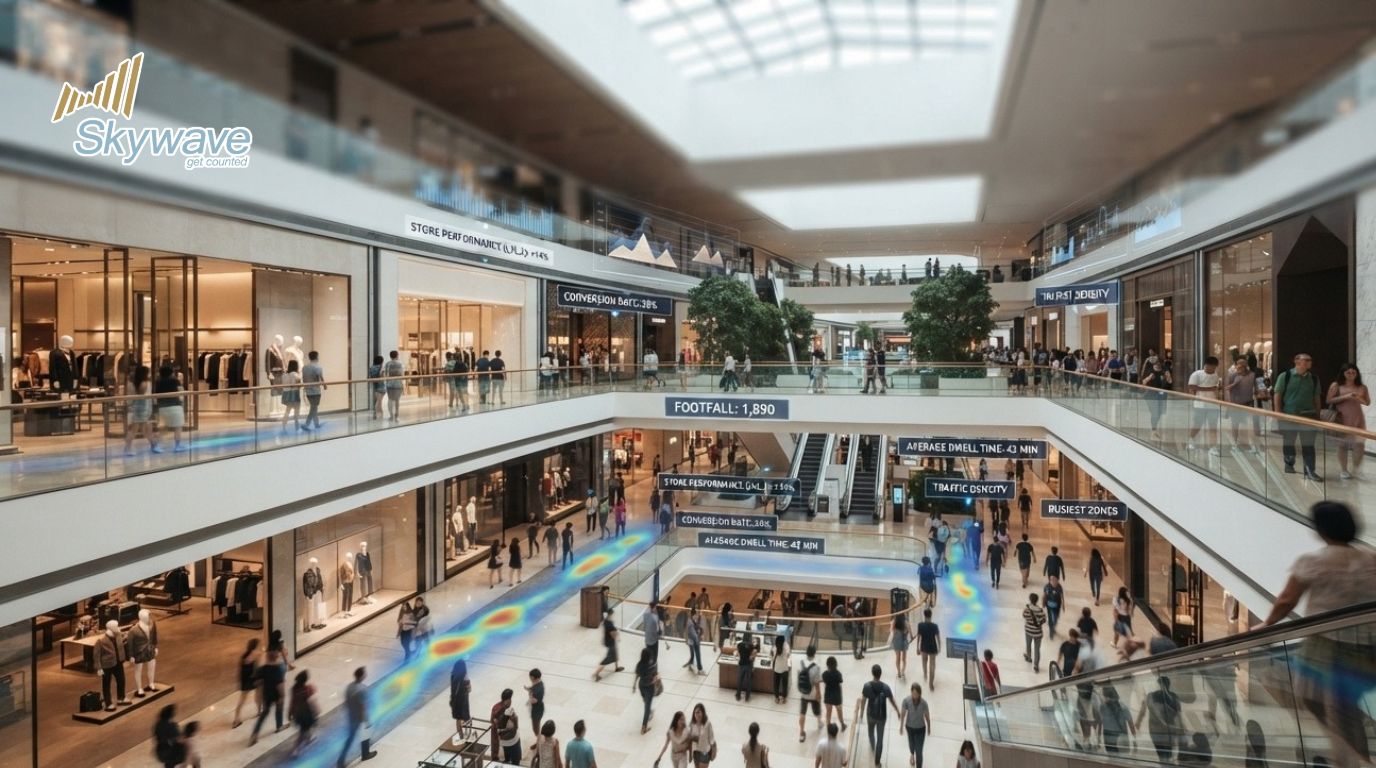
A mall can measure total visitors, but total traffic alone does not tell management everything it needs to know.
Where are visitors going?
Which zones are attracting traffic?
Which tenants benefit from that traffic?
How do campaigns change visitors’ behavior?
How does traffic vary by day and time?
Which areas consistently underperform?
How can tenant performance and traffic intelligence support leasing conversations?
This is the thinking behind the Mall Intelligence Loop:
Measure → Understand → Benchmark → Market → Grow
The objective is to move malls from simply counting visitors to making smarter commercial decisions.
Traffic intelligence can become relevant not only to mall operations, but also to marketing, leasing, tenant engagement and asset performance.
For example, zone-level traffic data can provide another evidence point when evaluating tenant performance, category placement, campaign impact or lease discussions.
The result is a shared intelligence layer connecting what happens across the mall with the commercial decisions management needs to make.
Data Reduces Decision Risk
No dataset can eliminate uncertainty.
And data should never be treated as a substitute for management experience.
Its value is different.
Data can reduce the risk of making decisions based purely on assumptions.
Instead of asking:
“What do we think is happening?”
management can increasingly ask:
“What does the evidence show, and what should we investigate next?”
That shift is particularly important when resources are constrained.
When budgets are tight, retailers need to know where investment is producing results.
When staffing is under pressure, they need to understand when and where resources are required.
When expansion decisions are being considered, they need comparable performance indicators.
When campaigns are launched, they need to understand whether activity is translating into meaningful business outcomes.
In uncertain markets, better visibility becomes a form of risk management.
The Future Is Not About More Dashboards
Retail leaders do not need another dashboard simply for the sake of having more information.
The real opportunity is to build a management system where data flows naturally into decisions.
Capture → Connect → Understand → Act.
That means collecting reliable data, connecting it with other business information, identifying meaningful patterns, and translating those patterns into practical actions.
This is also where the evolution of people counting becomes important.
People counting remains the foundation.
Footfall analytics adds context.
Retail intelligence turns that information into understanding.
Performance intelligence connects understanding to management decisions.
And ultimately, the goal is business growth.
Turning Uncertainty Into an Intelligence Advantage
Uncertainty is unlikely to disappear from retail.
Consumer expectations will continue to change. Competition will continue to evolve. Costs will fluctuate. New retail formats and technologies will continue to emerge.
Retail leaders cannot control all these external factors.
But they can control how quickly and accurately their organization responds.
The retailers that build stronger measurement and intelligence capabilities will have more visibility into what is happening across their stores—and more opportunities to act before small problems become larger ones.
The competitive question is therefore no longer simply:
“How much traffic are we getting?”
It is:
“What is our traffic telling us about our business, and what should we do next?”
That is the shift from people counting to performance intelligence.
And in uncertain markets, the ability to measure, understand, act and learn continuously can become one of the foundations of strategic resilience.
From Counting People to Understanding Performance
At Skywave, we have spent decades helping retailers, shopping malls and other high-traffic environments measure people’s movement.
Today, that foundation can go much further.
Our approach connects AI-powered people counting and footfall analytics with the broader questions that retail and mall leaders need to answer – from store performance and visitor behavior to benchmarking, marketing effectiveness and commercial decision-making.
Because the goal is not simply to know how many people walked through the door.
The goal is to help businesses understand what traffic means – and turn that understanding into better decisions.
Contact – Skywave – Measure. Understand. Optimize. Grow.