

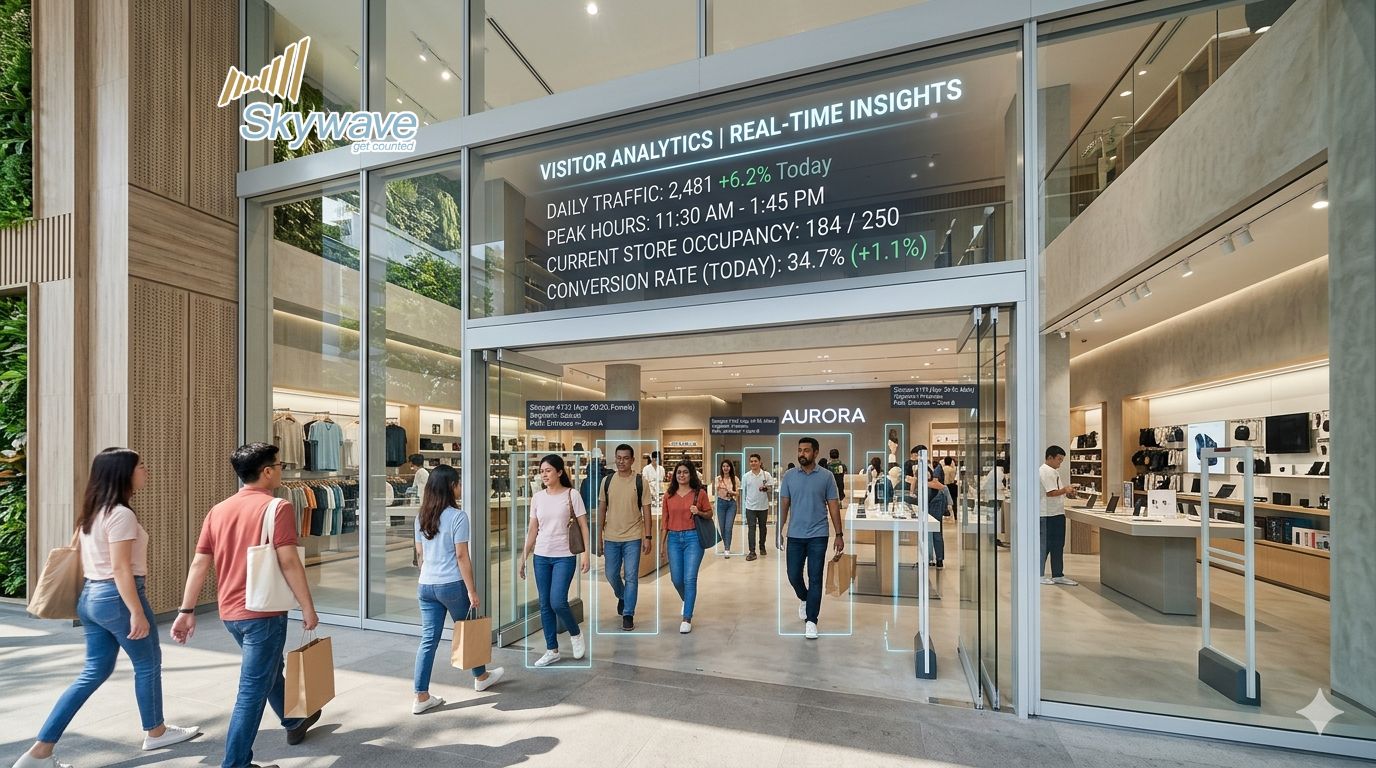
For years, many retailers have viewed AI-powered footfall counting with a mix of curiosity and caution. The idea sounded expensive, complex, and uncertain. But today, the reality is very different.
Across Southeast Asia—especially in markets like Malaysia and Singapore—AI footfall analytics has matured into a practical, accessible, and ROI-driven tool for retail decision-making.
At Skywave Systems, we’ve spent years helping malls, retailers, and public venues turn visitor traffic into real business insights. And one thing is clear: the biggest barrier today is no longer technology. It’s outdated perception.
Let’s break down the old fears—and the new reality.
The Old Fears Around AI Footfall Systems
Not long ago, retailers often had three major concerns:
- “AI is too expensive for us”
Many retailers assumed people-counting technology was only for mega malls or global flagship stores.
- “It won’t be accurate enough to trust”
Early counting systems struggled with occlusions, lighting, and crowded environments. Retailers worried they’d make decisions based on unreliable numbers.
- “We won’t know what to do with the data”
Even if the data were accurate, retailers feared it would be too technical, too complex, or disconnected from daily store operations.
These fears were valid—five to ten years ago. But technology has moved fast.
The New Reality: AI Footfall Has Grown Up
Today’s AI-powered footfall systems are not experimental tech. They’re mature, proven business tools.
Myth #1: AI Footfall Is Too Expensive
Reality: The cost barrier has dropped dramatically.
What changed?
- Hardware is smaller and more efficient
- AI processing is more affordable
- Cloud analytics removed heavy infrastructure costs
- Solutions are now scalable for single stores to entire chains
Retail technology has followed the same cost curve as cloud computing and POS systems. What was once enterprise-only is now accessible to mid-sized and even small retailers.
In fact, many retailers discover that the cost of not measuring traffic is far higher than implementing a system.
Because without footfall data, retailers are operating blind.
Myth #2: The Accuracy Isn’t Good Enough
Reality: Accuracy has improved massively.
Modern AI systems now use:
- 3D depth sensors
- Advanced computer vision
- AI trained on millions of real-world scenarios
This means they can reliably handle:
- Busy entrances
- Groups and families entering together
- Staff filtering
- Multiple entry/exit points
- Complex lighting environments
Accuracy levels today often exceed 95–99%, which is more than sufficient for operational and strategic decision-making.
Retailers are no longer guessing traffic trends—they’re measuring them with confidence.
Myth #3: The Data Is Too Technical
Reality: Insights are now simple and actionable.
The biggest shift isn’t just better counting—it’s better analytics.
Today’s dashboards answer real retail questions:
- How many people walk past vs enter the store?
- Which days and hours drive the most traffic?
- Are marketing campaigns increasing visits?
- Do staffing levels match peak traffic?
- Which stores convert best?
This is no longer “data science.” It’s daily retail intelligence.
From Fear to ROI: Where Footfall Data Creates Real Value
Let’s move from myths to measurable impact.
- Conversion Rate Visibility
Retailers already track sales.
But sales alone don’t tell the full story.
Footfall unlocks the missing metric:
Conversion Rate = Transactions ÷ Visitors
Now retailers can finally answer:
- Is low sales due to low traffic or poor conversion?
- Which stores convert best—and why?
This single metric transforms how performance is evaluated.
- Smarter Staffing Decisions
Staffing is one of the largest operational costs.
Without footfall data:
- Staffing schedules are based on intuition
- Peak hours are guessed
- Overstaffing and understaffing happen regularly
With footfall analytics:
- Staffing matches real traffic patterns
- Service improves during peak hours
- Labour costs become more efficient
Better customer experience + better cost control.
- Marketing That Can Be Measured
Retailers invest heavily in promotions, campaigns, and mall activations.
But the big question often remains:
Did it actually bring more people in?
Footfall analytics provides:
- Before vs after campaign comparisons
- Traffic uplift measurement
- Real ROI for marketing spend
For the first time, marketing moves from assumption → evidence.
- Store and Mall Negotiation Power
Footfall data is increasingly used in:
- Lease negotiations
- Store expansion decisions
- Location performance benchmarking
Retailers gain objective data to support strategic decisions.
The Biggest Shift: From “Nice-to-Have” to “Business Essential”
Footfall analytics used to be considered an optional innovation.
Today, it’s becoming as fundamental as:
- POS systems
- Inventory systems
- CRM tools
Retail is becoming data-driven—and traffic data is a critical piece of the puzzle.
Retailers who adopt early gain a competitive advantage.
Retailers who wait risk falling behind more data-savvy competitors.
So What Should Retailers Do Next?
If you’ve been hesitant about AI footfall systems, now is the time to revisit the conversation.
Start simple:
- Explore how footfall fits your current KPIs
- Identify one or two stores for pilot deployment
- Focus on quick wins: conversion, staffing, marketing ROI
The goal isn’t to become a tech company. The goal is to make better retail decisions.
Final Thought
The fear around AI footfall systems wasn’t irrational—it was just outdated.
Today’s reality is different:
- Costs are accessible
- Accuracy is proven
- ROI is clear
Retailers don’t need to fear AI footfall systems anymore. They need to start using them.
Curious how footfall analytics could work for your stores?
Let’s start the conversation. Contact – Skywave