

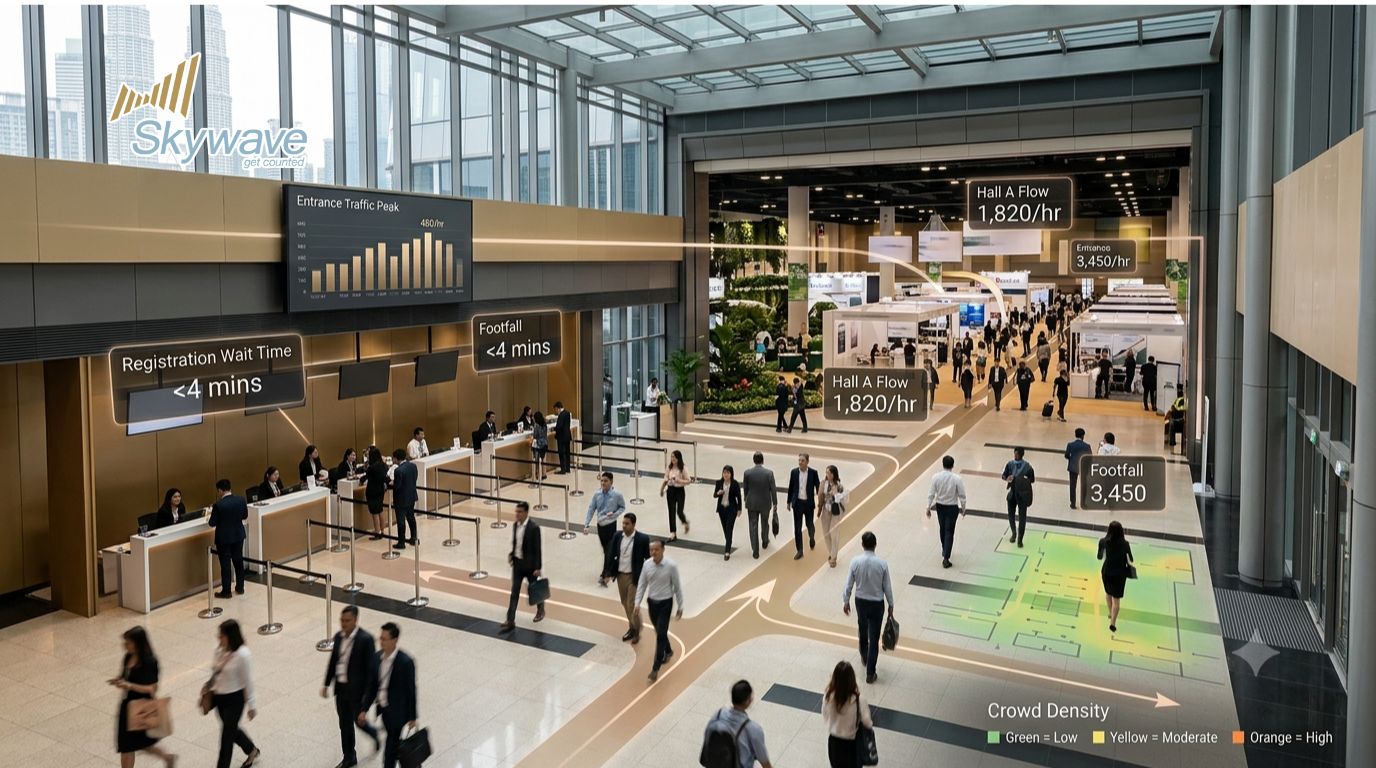
A successful event is not measured only by how many people attend. It is also measured by how smoothly visitors enter, how comfortably they move around the venue, and whether they leave with a positive impression.
From exhibitions and conferences to festivals and public events, organizers must balance strong attendance with safety, comfort, and operational efficiency.
By measuring traffic across entrances and time periods, teams can understand how crowds move, where pressure builds, and when more resources are needed. These insights improve both the live event and future planning.
Attendance Is Only the Beginning
Most organizers already track registrations, ticket sales, or RSVP numbers. However, registration data does not always reflect actual attendance.
Some registered guests may not arrive, while others attend walk-ins or re-enter during the day. A people counting system gives organizers a clearer view of actual visitor activity.
Instead of relying only on a final attendance number, organizers can understand:
- How many people actually entered
- When the busiest arrival periods occurred
- Which entrances handled the most traffic
- How traffic changed throughout the day
- Whether specific programmes attracted more visitors
- How attendance differed across event days
This turns attendance from a single figure into a measurable visitor journey.
1. Improve Entry Flow
The visitor experience begins before guests reach the exhibition hall, stage, or activity area.
Long queues, confusing entry points, and slow registration create frustration. A poor arrival experience can affect how visitors feel about the entire event.
Identify Peak Arrival Periods
Visitor traffic is rarely even throughout the day.
A conference may have a morning rush, while an exhibition or festival may peak later around a major programme.
By measuring entries by hour, organizers can prepare more accurately by opening more counters, adding ushers or security staff, separating registration queues, and improving signage.
Instead of using the same staffing level all day, organizers can match manpower and facilities to actual demand.
This can reduce waiting times while creating a more organized and welcoming arrival experience.
Compare Entrance Performance
Large venues often have several access points, but visitors may not use them equally.
One entrance may become congested while another remains underused because of transport access, signage, registration, or nearby attractions.
Entrance-level footfall data allows organizers to compare traffic distribution. The team can then redirect visitors, reposition staff, improve signage, or promote alternative access points.
The goal is not simply to move people through the door faster. It is to create a smooth and welcoming arrival experience.
2. Manage Peak Periods More Effectively
Crowd conditions can change quickly during an event.
A popular speaker, giveaway, or performance may create a sudden surge. Food areas may crowd during breaks, while exits may become busy when sessions end.
Without reliable data, organizers may only react after congestion becomes visible. Footfall analytics provides a more structured way to prepare.
Plan Manpower Based on Demand
Security staff, ushers, registration teams, cleaners, and technical support are often scheduled using estimates or past experience. Historical footfall data makes this planning more accurate.
Organizers can see when staffing should increase and where support is required. For multi-day events, first-day data can guide quick adjustments.
If Saturday afternoon was busier than expected, the team could strengthen staffing, registration capacity, and crowd-control arrangements for Sunday.
This allows organizers to allocate resources where they create the greatest operational value rather than maintaining the same staffing level throughout the event.
Reduce Crowding Pressure
Footfall data can help event teams recognize when visitor numbers are approaching uncomfortable levels.
Organizers may monitor overall attendance, entrance activity, or selected areas. When traffic rises, the team can redirect visitors, control entry, open access points, adjust queues, or deploy more staff.
This allows organizers to act before crowding affects safety, comfort, or the overall experience.
Footfall information should complement the event team’s existing safety procedures, venue capacity limits, and on-site observations. Together, these provide a stronger foundation for proactive crowd management.
Understand Programme-Driven Traffic
Event traffic is often influenced by the programme schedule.
A keynote, celebrity appearance, or promotion may create a short but intense traffic peak.
By comparing footfall patterns with the programme, organizers can understand which activities attracted visitors and how they affected movement. This makes the data useful for both operations and future programme planning.
For example, organizers may decide to move a popular activity to a larger area, introduce more time between major sessions, or strengthen crowd-control measures around high-interest programmes.
3. Design a Better Visitor Experience
The best event experiences feel effortless. Visitors can find their way around, reach the activities they want, and move between areas without unnecessary delays or confusion.
Footfall analytics helps organizers understand whether the event layout supports this experience.
Improve the Event Layout
Visitor movement can reveal how people respond to the venue design.
If one entrance receives most of the traffic, nearby booths gain more exposure. If visitors remain near the front, deeper areas may need stronger attractions, better signage, or a different layout.
Organizers can study traffic entering selected halls or activity areas. The findings may support repositioning attractions, relocating counters, creating clearer pathways, and reducing bottlenecks.
Other improvements may include distributing seating, food areas, information counters, and rest facilities more evenly throughout the venue.
The objective is to design an event that encourages visitors to explore comfortably rather than concentrating on everyone in the same areas.
Evaluate Activities and Attractions
Main entrance attendance shows how many people came, but not necessarily what interested them once they entered.
By measuring selected areas, organizers can identify popular programmes, underperforming zones, campaign impact, and whether a new layout improved visitor distribution.
These insights provide a more objective basis for deciding which activities to retain, expand, reposition, or redesign.
For recurring events, organizers can also compare different editions to determine whether changes to the programme or layout produced measurable improvements.
Strengthen Sponsor and Exhibitor Reporting
Sponsors and exhibitors increasingly expect measurable outcomes.
Total attendance is still important, but detailed traffic information can make post-event reports more credible. Organizers may report verified attendance, traffic by day and hour, peak periods, entrance distribution, programme-related traffic, and comparisons with previous events.
This helps demonstrate event reach and operational performance while giving sponsors greater confidence in future participation.
It can also help organizers provide more meaningful discussions around booth locations, programme sponsorships, promotional timing, and future event opportunities.
Useful Insights Without Identifying Visitors
Modern people counting solutions focus on aggregated traffic patterns rather than identifying individuals.
Organizers can understand how many people entered, when they arrived, and how crowds moved while taking a privacy-conscious approach.
The purpose is operational improvement: creating safer, smoother, and more comfortable event experiences.
Turn Every Event into a Learning Opportunity
Each event generates valuable operational knowledge. Without measurement, much of it depends on observation, memory, or anecdotal feedback.
Footfall analytics creates a record for comparing planned attendance with actual turnout, different event days and entrances, peak periods, and previous editions.
Over time, this supports better decisions on venue selection, programme scheduling, manpower planning, marketing, and crowd management.
Instead of starting every event from assumptions, organizers can build on reliable historical data.
This creates a continuous improvement cycle where each event provides practical insights for the next.
From Crowd Counting to Crowd Intelligence
Footfall data is not just about counting people. It is about understanding how visitors experience the event.
It helps organizers improve entry planning, manage peak periods, refine layouts, evaluate activities, and provide stronger reporting to stakeholders.
Most importantly, it allows teams to make decisions based on how visitors actually behave, not how they were expected to behave.
When organizers can attract, measure, understand, and optimize visitor traffic, each event becomes an opportunity to improve the next one.
Make Your Next Event More Measurable
Skywave provides people counting and footfall analytics solutions for exhibitions, conferences, festivals, public events, and temporary venues.
Whether you need to measure attendance, compare entrance performance, or understand hourly visitor traffic, Skywave can help turn event activity into practical operational insights.
Contact – Skywave to explore a people counting solution for your next event.